PEG-MGF
PEGylated variant of Mechano Growth Factor (IGF-1Ec splice variant) with extended half-life for systemic use.
🔬 Mechanism of Action
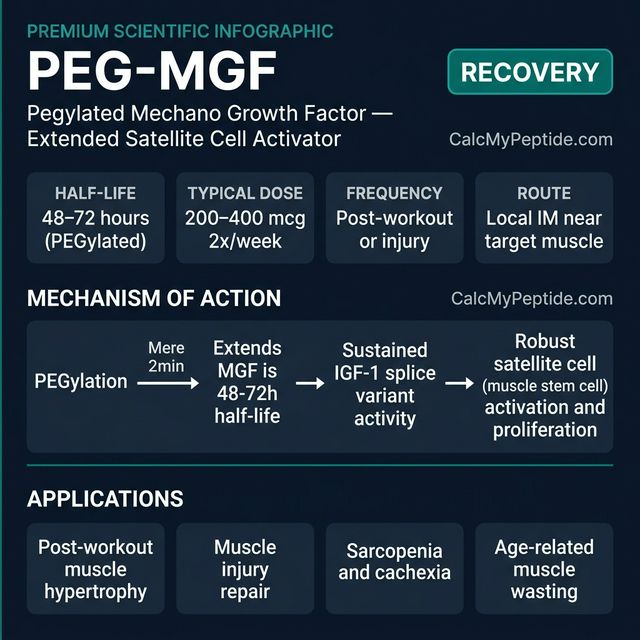
PEG-MGF (PEGylated Mechano Growth Factor) is a modified version of MGF (IGF-1Ec splice variant) with polyethylene glycol (PEG) conjugation. Natural MGF has an extremely short half-life (~5-7 minutes), limiting its use to local injection. PEGylation extends the systemic half-life to several days.
MGF is naturally produced in muscle tissue after mechanical damage (exercise). It activates satellite cells — the muscle stem cells responsible for repair and hypertrophy. PEG-MGF provides systemic satellite cell activation rather than requiring site-specific injection.
Source: PMID: 15735070
📜Background & History
PEG-MGF (Pegylated Mechano Growth Factor) is a polyethylene glycol (PEG)-modified form of MGF — itself a splice variant of IGF-1 generated in muscle tissue after mechanical stress. The PEGylation dramatically extends the half-life from ~2 minutes (native MGF peptide) to approximately 48-72 hours. MGF was discovered by Geoffrey Goldspink at University College London who showed exercise-induced local IGF-1 splice to MGF is the primary driver of satellite cell (muscle stem cell) activation and hypertrophy signaling.
🎯 Research Use Cases
- ✓Post-workout muscle hypertrophy and satellite cell activation
- ✓Recover from muscle injury with satellite cell proliferation
- ✓Cachexia: muscle wasting prevention in chronic disease
- ✓Age-related sarcopenia management
💉 Dosing Protocol
| Typical Dose | 200-400 mcg/day |
| Frequency | 2-3× weekly |
| Half-Life | ~3-5 days (PEGylated) |
| Common Vial Sizes | 2 mg, 5 mg |
🧪 Reconstitution Example
⚠️Safety & Considerations
Research peptide. The PEG modification may cause immune sensitization in rare cases. Start with lower doses. Not recommended for individuals with active cancers due to growth factor properties.
⚡Interactions & Contraindications
Localized satellite cell activation — inject near the muscle group targeted. PEG moiety may cause antibody formation with very long-term repeated use (PEG immunogenicity). Hypoglycemia risk at very high doses via IGF-1-like receptor activation. Contraindicated with active cancer.
🔗Synergies & Common Stacks
MGF activates satellite cells locally; IGF-1 LR3 drives systemic anabolic signaling via the IGF-1 receptor. Sequence them: PEG-MGF post-workout, IGF-1 LR3 follows to drive the cells that MGF activated.
BPC-157 repairs the vascular and structural components; PEG-MGF drives satellite cell proliferation for muscle-specific repair. Complete muscle injury recovery stack.
❓ Frequently Asked Questions
What is the difference between MGF and PEG-MGF?▼
When should I inject PEG-MGF?▼
📖 References
- Hill M, Goldspink G. “Mechano growth factor expression in skeletal muscle following mechanical overload.” Growth Factors (2003). PMID: 14626773