BPC-157
Gastric pentadecapeptide studied for tissue repair, tendon healing, and GI protection.
🔬 Mechanism of Action
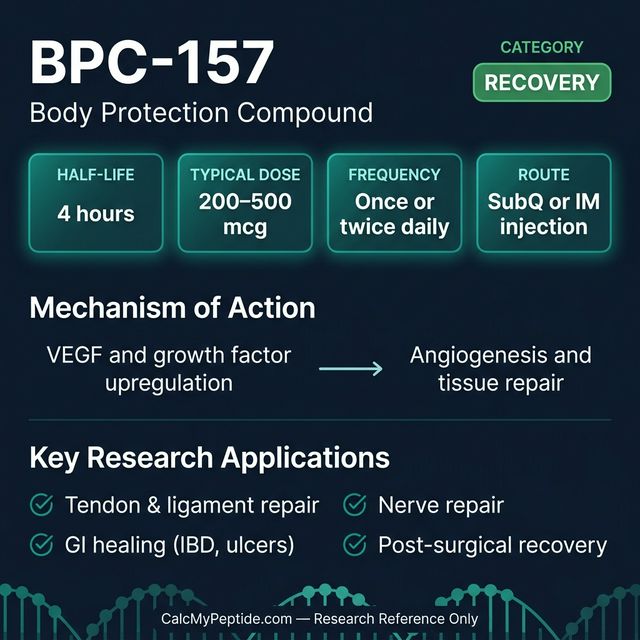
BPC-157 (Body Protection Compound-157) is a pentadecapeptide consisting of 15 amino acids derived from human gastric juice. Its primary mechanism involves upregulation of growth factor expression, including VEGF (Vascular Endothelial Growth Factor) and FGF (Fibroblast Growth Factor), which promote angiogenesis — the formation of new blood vessels. This enhanced blood supply accelerates tissue repair in tendons, ligaments, muscles, and the gastrointestinal tract.
BPC-157 also modulates the nitric oxide (NO) system, which plays a critical role in blood vessel formation and wound healing. Studies demonstrate its ability to counteract the damage caused by NSAIDs on the gastric mucosa, and to promote tendon-to-bone healing in animal models. It has additionally shown neuroprotective effects and the ability to counteract dopaminergic system disturbances.
Source: PMID: 29936067, PMID: 30915550
📜Background & History
BPC-157 (Body Protection Compound-157) was first isolated from human gastric juice by Croatian pharmacologist Predrag Sikiric in the 1990s. The 15-amino-acid pentadecapeptide was engineered to be stable in gastric acid — unlike most peptides — enabling both oral and injectable administration. Decades of animal model research at the University of Zagreb have documented its systemic healing effects across virtually every tissue type.
🎯 Research Use Cases
- ✓Tendon and ligament repair after acute injury or overuse
- ✓Gastrointestinal healing: IBD, leaky gut, NSAID-induced ulcers
- ✓Accelerating bone fracture healing
- ✓Nerve repair and neuroprotection after spinal or peripheral injury
- ✓Reducing post-surgical adhesions and inflammation
💉 Dosing Protocol
| Typical Dose | 200-800 mcg/day |
| Frequency | 1-2× daily |
| Half-Life | 4 hours |
| Common Vial Sizes | 5 mg |
🧪 Reconstitution Example
⚠️Safety & Considerations
BPC-157 is a research peptide not approved by the FDA for human use. Animal studies show an excellent safety profile with no reported toxicity at therapeutic doses. As with all injectable peptides, maintain sterile injection technique. BPC-157 should not be used by individuals with active cancer due to its angiogenic properties.
⚡Interactions & Contraindications
Avoid concurrent use with active cancer treatment — angiogenic properties may theoretically promote tumor vascularization. NSAIDs blunt the prostaglandin pathway BPC-157 modulates; minimize concurrent use. No established drug-drug interactions with common medications at research doses.
🔗Synergies & Common Stacks
The most studied peptide stack for recovery: BPC-157 drives localized VEGF/FGF healing while TB-500 provides systemic actin-mediated repair. Together they cover both local and systemic dimensions.
GHK-Cu amplifies collagen synthesis alongside BPC-157's angiogenic effects, enhancing tissue remodeling especially in skin and connective tissue repairs.
MGF activates satellite cells for muscle repair while BPC-157 handles the vascular and structural repair phase, making this stack useful for muscle injuries.
❓ Frequently Asked Questions
What is the standard BPC-157 dose?▼
How long should I run a BPC-157 cycle?▼
Should I inject BPC-157 near the injury site?▼
Can I stack BPC-157 with TB-500?▼
📖 References
- Sikiric P, et al. “Stable gastric pentadecapeptide BPC 157 in trials for inflammatory bowel disease.” J Physiol Pharmacol (2006). PMID: 17106110
- Chang CH, et al. “Pentadecapeptide BPC 157 enhances the growth hormone receptor expression in tendon fibroblasts.” Molecules (2014). PMID: 25607720
- Staresinic M, et al. “BPC 157 and its role in accelerating tendon-to-bone healing.” J Orthop Res (2006). PMID: 17001690