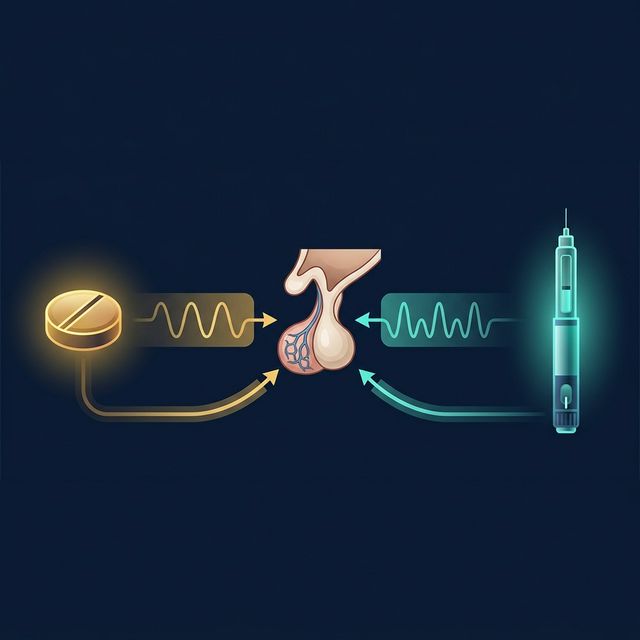
The Cost Question Everyone Asks
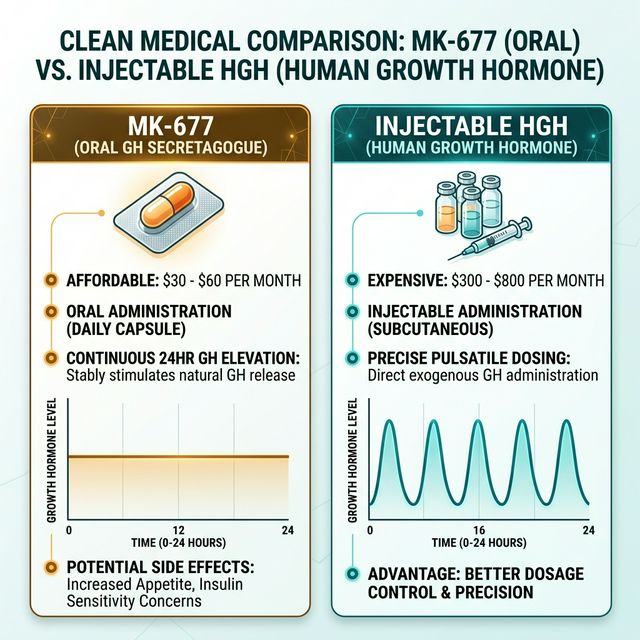
MK-677 costs approximately $30-60 per month. Pharmaceutical HGH costs $800-3,000 per month. That is a 20-50 fold price difference. And MK-677 is a pill. HGH requires daily subcutaneous injection. So what is the catch?
MK-677 (ibutamoren) is not technically a peptide — it is a non-peptide, orally active growth hormone secretagogue. It mimics ghrelin by activating the GHS-R1a receptor, which then signals the pituitary to release growth hormone. It does this continuously for approximately 24 hours per oral dose, producing sustained (not pulsatile) GH elevation and robust IGF-1 increases.
Recombinant human growth hormone (hGH) — brand names include Genotropin, Norditropin, Humatrope — is the actual hormone itself. When you inject GH, you bypass the pituitary entirely and deliver exogenous GH directly into the bloodstream. The resulting GH spike is dose-dependent, predictable, and powerful. It is also the gold standard that all GH optimization strategies are benchmarked against.
IGF-1 Response: The Primary Efficacy Marker
Both MK-677 and hGH reliably increase IGF-1 — the primary downstream marker of GH activity and the molecule responsible for most of GH's anabolic, recovery, and anti-aging effects. The question is: how much, and through what pattern?
MK-677 data: In the definitive long-term study (Murphy et al., JCEM 2001), MK-677 25 mg/day for 12 months in elderly subjects increased IGF-1 by a mean of 97% — from approximately 116 ng/mL to 224 ng/mL. This put mean IGF-1 levels into the range typical of young healthy adults. This was a 2-year study, and the IGF-1 elevation was maintained throughout without tachyphylaxis.
HGH data: The IGF-1 response to hGH is dose-dependent and more variable. At typical anti-aging doses (1-2 IU/day), IGF-1 increases of 50-100% are typical. At performance doses (3-6 IU/day), IGF-1 increases of 150-300% are possible. The advantage of hGH is dose-response linearity — you can titrate the IGF-1 level precisely by adjusting the dose.
On IGF-1 elevation alone, MK-677 at 25 mg/day produces results comparable to hGH at 1-2 IU/day. But IGF-1 is only one piece of the picture.
Side Effects: Where MK-677 Falls Short
MK-677 has three significant side effects that hGH does not share: (1) appetite stimulation — MK-677 activates GHS-R1a systemically, including in the hypothalamus and vagal afferent neurons, producing significant hunger increases in approximately 60-80% of users. This is counterproductive for fat loss and can be difficult to manage. HGH does not stimulate appetite. (2) Blood glucose elevation — In Murphy et al. (JCEM 1998), MK-677 increased fasting blood glucose by approximately 0.3 mmol/L and decreased insulin sensitivity in approximately 30% of subjects. This is mediated by 24-hour sustained GH elevation (GH is a counter-regulatory hormone that opposes insulin action). HGH has the same theoretical concern but the pulsatile pattern (single daily injection, GH clears to baseline within 4-6 hours) disrupts glucose less than 24-hour continuous elevation. (3) Water retention and edema — sustained GH elevation promotes sodium and water retention. MK-677 users frequently report facial bloating, peripheral edema, and 2-5 kg water weight gain.
HGH side effects at anti-aging doses (1-2 IU/day) are generally milder: mild water retention, temporary joint stiffness, occasional carpal tunnel symptoms. These are dose-dependent and resolve with dose reduction. At higher performance doses, hGH side effects include insulin resistance, acromegaly-like changes, and organ enlargement (long-term high-dose only).
The GH Pattern Problem: Pulsatile vs Continuous
This is the most important distinction that most comparisons skip. The pattern of GH elevation matters as much as the total amount.
Natural GH secretion is pulsatile — 3-5 sharp pulses per day, mostly during sleep. The off-periods between pulses are not dead time; they are when GH receptors resensitize, hepatic IGF-1 production normalizes, and insulin sensitivity recovers. HGH injection produces a pulse-like pattern: GH spikes after injection, peaks at 2-4 hours, and clears to baseline by 6-8 hours. This roughly mimics natural pulsatility.
MK-677 produces 24-hour continuous GH elevation. There are no off-periods for receptor resensitization. Hepatic and peripheral tissues are continuously stimulated. Insulin counter-regulation operates around the clock. This tonic pattern is more efficient at raising total daily GH exposure and IGF-1, but it is less physiological and carries greater metabolic side effects.
The clinical implication: for pure IGF-1 elevation (muscle, recovery, collagen synthesis), MK-677 is effective and dramatically cheaper. For metabolically cleaner GH optimization with fewer side effects, hGH (or injectable secretagogues like ipamorelin + CJC-1295) is superior.
The Verdict: Different Tools for Different Goals
MK-677 is a legitimate tool for GH/IGF-1 optimization at a fraction of hGH's cost. It works. The IGF-1 data over 2 years is convincing. But it is not hGH, and claiming equivalence ignores the pattern, side effect, and metabolic differences.
Choose MK-677 if: budget is the primary constraint; your goal is elevated IGF-1 for recovery, sleep quality, and lean mass; you can manage appetite stimulation; you will monitor fasting glucose and HbA1c every 4-6 weeks; you prefer oral dosing.
Choose hGH if: you have the budget ($800+/month); you want pulsatile GH delivery; fat loss is a primary goal (appetite stimulation from MK-677 is counterproductive); you have insulin sensitivity concerns; you value dose-response precision.
Choose injectable secretagogues (ipamorelin + CJC-1295 no DAC) if: you want the best of both worlds — pulsatile GH like hGH, at a cost closer to MK-677, with the cleanest hormonal side effect profile of any option. Use the CalcMyPeptide half-life visualizer to compare decay curves across these compounds.