What Is the Wolverine Stack?
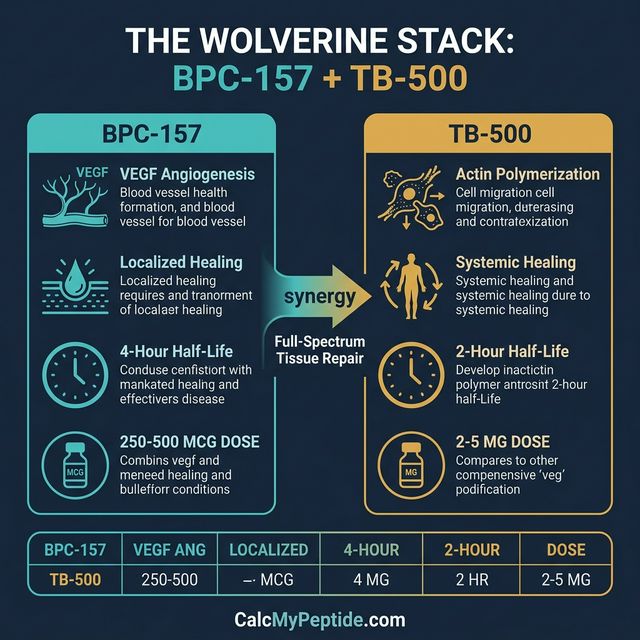
The Wolverine Stack is a peptide recovery protocol combining BPC-157 (Body Protection Compound-157) and TB-500 (Thymosin Beta-4 fragment), named for its association with accelerated tissue repair in biohacking and sports recovery communities. BPC-157 upregulates VEGF and FGF to drive localized angiogenesis with a 4-hour half-life (Sikiric P et al., Curr Neuropharmacol, 2016, PMID: 26830965), while TB-500 promotes systemic cell migration via actin polymerization with a ~2-hour half-life (Goldstein AL et al., Expert Opin Biol Ther, 2012, PMID: 22171665). CalcMyPeptide provides a free Blend/Stack Calculator with Wolverine, GLOW, and KLOW presets that computes exact reconstitution volumes and syringe units for any vial configuration.
Why Is It Called the Wolverine Stack?
The name "Wolverine Stack" is a cultural reference to the Marvel Comics character Wolverine (Logan), whose mutant healing factor allows him to regenerate from virtually any injury within seconds. The biohacking community adopted this name because BPC-157 + TB-500 is the closest pharmacological analog to rapid, multi-tissue regeneration currently available in peptide research.
The term gained mainstream traction through TikTok, where the Wolverine Stack discover page has accumulated millions of views as of March 2026. Reddit communities — particularly r/Peptides and r/biohacking — along with YouTube breakdown videos and biohacking podcasts further popularized the protocol.
It is important to note that "Wolverine Stack" is a colloquial community name, not a clinical or scientific term. There is no FDA-approved product called the "Wolverine Stack." However, some compounding pharmacies and peptide clinics now sell pre-mixed BPC-157 + TB-500 vials marketed under this name, often at premiums exceeding $300 per vial.
How the Wolverine Stack Works: Dual-Mechanism Pharmacology
The Wolverine Stack derives its efficacy from combining two peptides with fundamentally different — and complementary — healing mechanisms.
BPC-157 is a gastric pentadecapeptide that upregulates Vascular Endothelial Growth Factor (VEGF) and Fibroblast Growth Factor (FGF), driving localized angiogenesis — the formation of new blood vessels at the injury site (Seiwerth S et al., Life Sci, 2018, PMID: 29408228). It also modulates the nitric oxide (NO) system and has demonstrated cytoprotective and neuroprotective effects across 100+ animal studies (Sikiric P et al., Curr Pharm Des, 2018, PMID: 29569996). For a deep dive, see the BPC-157 peptide profile.
TB-500 is a fragment of Thymosin Beta-4 that promotes actin polymerization — the process by which structural proteins assemble to enable cell migration to injury sites throughout the body (Goldstein AL et al., Expert Opin Biol Ther, 2012, PMID: 22171665). TB-500 also demonstrates cardioprotective properties (Bock-Marquette I et al., Nature, 2004, PMID: 15229613) and promotes dermal wound healing (Malinda KM et al., J Invest Dermatol, 1999, PMID: 10469329). See the TB-500 peptide profile for full details.
The analogy that captures their synergy: BPC-157 builds the roads; TB-500 sends the trucks. BPC-157 creates the vascular infrastructure (blood supply) needed for healing, while TB-500 delivers the repair cells through that infrastructure. Together, they cover both halves of the tissue repair equation.
| Property | BPC-157 | TB-500 |
|---|---|---|
| Origin | Gastric pentadecapeptide | Thymosin Beta-4 fragment |
| Primary mechanism | VEGF/FGF → angiogenesis | Actin polymerization → cell migration |
| Half-life | ~4 hours | ~2 hours (active metabolites longer) |
| Injection site preference | Near injury (localized) | Anywhere (systemic) |
| Standard dose | 250–500 mcg/day SubQ | 2–5 mg twice weekly SubQ |
| Common vial size | 5 mg | 5 mg or 10 mg |
| Best for | Tendons, GI, localized injury | Systemic recovery, cardiac, diffuse inflammation |
| Research volume | 100+ animal studies | 50+ animal studies |
For a detailed head-to-head analysis, read our BPC-157 vs TB-500 deep-dive comparison.
Wolverine Stack Dosing Protocol
BPC-157: 250–500 mcg subcutaneously, 1–2× daily, injected near the injury site when possible. Standard cycle length is 4–8 weeks. The 4-hour half-life supports twice-daily dosing for optimal blood level maintenance. For detailed dosing strategies, see our BPC-157 dosage guide.
TB-500: Loading phase — 2–5 mg twice weekly for 4–6 weeks. Maintenance phase — 2 mg once weekly. TB-500 distributes systemically regardless of injection site, so abdomen or thigh injections are standard.
Combined protocol: Inject BPC-157 daily near the injury site + TB-500 twice weekly anywhere (abdomen or thigh). The two peptides are typically reconstituted in separate vials and drawn with separate syringes.
Timing: Neither BPC-157 nor TB-500 has food interaction requirements, unlike GH secretagogues which require fasting. Inject at any time of day with consistent scheduling.
Cycle length: 6–8 weeks is most common in community protocols, followed by a 2–4 week break before repeating if needed.
⚠️ These are research protocols documented in the peptide community. They are NOT FDA-approved treatment regimens. BPC-157 is banned by WADA (World Anti-Doping Agency). Consult a qualified healthcare provider before using any peptide.
Wolverine Stack Reconstitution: Step-by-Step Math
This is the section that separates CalcMyPeptide from every other Wolverine Stack guide on the internet. No competing page provides the actual reconstitution math with syringe unit calculations. Here it is:
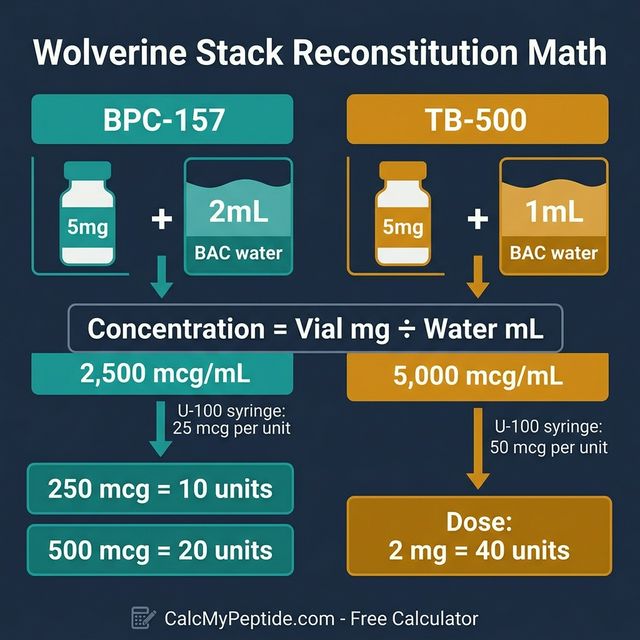
BPC-157 Reconstitution Worked Example:
• Vial: 5 mg BPC-157 lyophilized powder
• BAC water added: 2 mL (bacteriostatic water — see our bacteriostatic water guide)
• On a U-100 (100-unit) insulin syringe: 2,500 ÷ 100 = 25 mcg per unit
• For 250 mcg dose: 250 ÷ 25 = 10 units
• For 500 mcg dose: 500 ÷ 25 = 20 units
• On a 0.3 mL (30-unit) syringe: 2,500 ÷ 30 = 83.3 mcg per unit
• For 250 mcg dose: 250 ÷ 83.3 ≈ 3 units
TB-500 Reconstitution Worked Example:
• Vial: 5 mg TB-500 lyophilized powder
• BAC water added: 2 mL
• On a U-100 syringe: 25 mcg per unit
• For 2 mg (2,000 mcg) dose: 2,000 ÷ 25 = 80 units
• For 2.5 mg dose: 2,500 ÷ 25 = 100 units (full syringe)
• Note: For TB-500 doses above 2.5 mg, either use a 1.0 mL syringe or reconstitute with more water
💡 Pro Tip: Adding more BAC water decreases concentration but increases measurement precision. For TB-500's larger doses, 1 mL of BAC water gives 5 mg/mL = 50 mcg per unit, making 2 mg = 40 units — a comfortable draw on any syringe. This is typically the sweet spot for TB-500 reconstitution.
Skip the math — enter your vial size, BAC water volume, and syringe type into the CalcMyPeptide reconstitution calculator for instant results.
The Wolverine Stack Variants: GLOW and KLOW
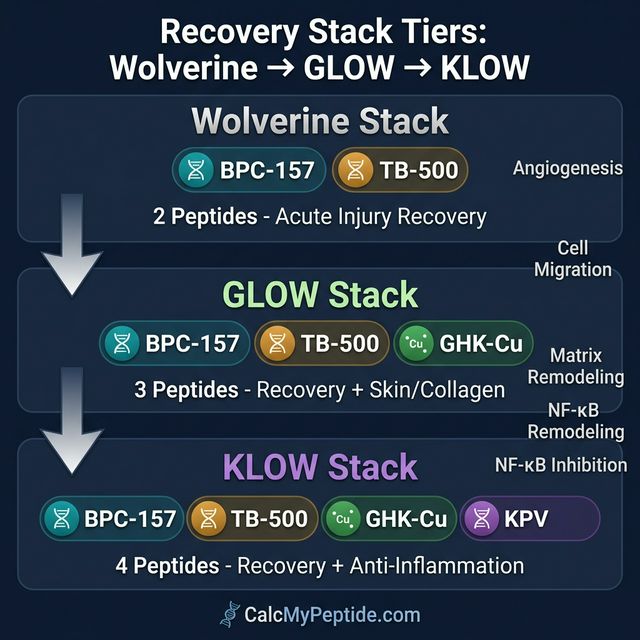
The basic Wolverine Stack (BPC-157 + TB-500) is the foundation. The biohacking community has evolved it into two enhanced variants with additional peptides:
GLOW Stack = Wolverine + GHK-Cu: The GLOW stack adds GHK-Cu copper peptide (Pickart L et al., Biomed Res Int, 2015, PMID: 25861634) to the base Wolverine protocol. GHK-Cu addresses the extracellular matrix remodeling that BPC-157 and TB-500 don't directly target — driving collagen and elastin synthesis, improving skin quality, and stimulating hair follicle cycling. This creates three-axis coverage: vascular (BPC-157) + cellular migration (TB-500) + matrix remodeling (GHK-Cu). View the full GLOW stack profile.
KLOW Stack = GLOW + KPV: The KLOW stack adds KPV anti-inflammatory peptide (an alpha-MSH C-terminal tripeptide) to the full GLOW protocol. KPV inhibits NF-κB signaling and suppresses TNF-α, IL-1β, and IL-6 production (Luger TA et al., Ann Rheum Dis, 2000, PMID: 10817504), removing the inflammatory microenvironment that impairs repair. KLOW is preferred for chronic inflammatory conditions, autoimmune flares, and gut issues. View the full KLOW stack profile.
| Stack | Peptides | Best For | Key Addition |
|---|---|---|---|
| Wolverine | BPC-157 + TB-500 | Acute injury recovery | — |
| GLOW | BPC-157 + TB-500 + GHK-Cu | Recovery + skin/hair/collagen | Extracellular matrix remodeling |
| KLOW | BPC-157 + TB-500 + GHK-Cu + KPV | Recovery + inflammation control | NF-κB inhibition |
Use the CalcMyPeptide Blend/Stack Calculator with GLOW and KLOW presets to calculate exact draw units for multi-peptide vials.
Reconstituting a Wolverine Stack Blend Vial
Some users reconstitute BPC-157 and TB-500 in separate vials (two injections). Others combine them in one vial for a single injection. Here is the combined-vial math:
• Vial contains: BPC-157 5 mg + TB-500 5 mg = 10 mg total peptide
• Add 2 mL BAC water
• Total concentration: 10 ÷ 2 = 5 mg/mL
• BPC-157 concentration: 5 ÷ 2 = 2.5 mg/mL = 2,500 mcg/mL
• TB-500 concentration: 5 ÷ 2 = 2.5 mg/mL = 2,500 mcg/mL
• On a U-100 syringe: each unit delivers 25 mcg BPC-157 AND 25 mcg TB-500 simultaneously
• For 250 mcg BPC-157 + 250 mcg TB-500: draw 10 units
⚠️ Important ratio note: This blend delivers equal amounts of each peptide per unit. But TB-500 is typically dosed at 2–5 mg (not 250 mcg), creating a significant dose mismatch. This is why pre-mixed Wolverine vials from compounding pharmacies usually have asymmetric ratios — for example, BPC-157 5 mg + TB-500 20 mg — to align draw volumes with each peptide's target dose.
The CalcMyPeptide Blend/Stack Calculator handles asymmetric ratios automatically. Enter each peptide's mg amount and the calculator determines your draw volume based on whichever peptide you set as the dose target.
How Long Does a Wolverine Stack Vial Last?
Understanding vial duration helps you plan costs and ordering schedules:
• BPC-157 5 mg vial at 250 mcg/day = 5,000 ÷ 250 = 20 days
• BPC-157 5 mg vial at 500 mcg/day = 5,000 ÷ 500 = 10 days
• TB-500 5 mg vial at 2 mg twice weekly (4 mg/week) = 5,000 ÷ 4,000 = 1.25 weeks (~9 days)
• TB-500 10 mg vial at 2 mg twice weekly = 10,000 ÷ 4,000 = 2.5 weeks (~18 days)
Reconstituted peptides must be used within 28 days when mixed with BAC water (Manning MC et al., Pharm Res, 2010, PMID: 20499271). A 5 mg BPC-157 vial at 250 mcg/day lasts exactly 20 days — well within the 28-day window. Read more about how long a peptide vial lasts.
Calculate exactly how long your vials will last with the CalcMyPeptide Vial Duration Calculator.
Storage, Handling, and Safety
Proper storage and technique are critical for maintaining peptide potency and injection safety:
• Reconstituted vials: Refrigerate at 2–8°C (36–46°F), use within 28 days, protect from light. See our peptide storage guide for complete guidelines.
• Lyophilized (unreconstituted): Store at -20°C to 4°C, stable for 12–24 months
• Never freeze reconstituted peptides — ice crystals destroy the 3D molecular structure
• Rotate injection sites to prevent lipodystrophy
• Sterile technique: Alcohol swab vial tops, use a new syringe each injection, inject BAC water down the side of the vial (never directly into the powder), swirl gently (never shake). See our peptide injection master guide for detailed technique instructions.
• Discard if: solution is cloudy, particles are visible, color change occurs, or vial is past 28 days
• Verify your peptide source using our guide to how to verify peptide purity
⚠️ Angiogenesis warning: Both BPC-157 and TB-500 promote new blood vessel formation. This mechanism is therapeutic for healing but theoretically supports tumor growth. Do not use with active cancer or history of cancer within 5 years. Read our full peptide side effects by category guide for monitoring protocols.
Frequently Asked Questions
What is the Wolverine Stack?+
What is the difference between the Wolverine Stack, GLOW, and KLOW?+
How many units of BPC-157 should I draw for a 250 mcg dose?+
Can BPC-157 and TB-500 be mixed in the same vial?+
How long does a Wolverine Stack cycle last?+
Is the Wolverine Stack FDA approved?+
Where should I inject the Wolverine Stack?+
What are the side effects of the Wolverine Stack?+
How Do You Reconstitute the Wolverine Stack with Bacteriostatic Water?
To reconstitute the Wolverine Stack, prepare each vial separately. Remove the plastic flip-cap, swab the rubber stopper with 70% isopropyl alcohol, and let it air-dry for 10 seconds. Draw your chosen volume of bacteriostatic water (typically 1–2 mL) into a fresh sterile insulin syringe. Insert the needle through the stopper at a slight angle and slowly inject the BAC water down the inside wall of the vial — never spray directly onto the lyophilized peptide cake. Allow the water to trickle down by gravity, then gently swirl (never shake) until the powder is fully dissolved. The resulting solution should be perfectly clear and colorless. Label the vial with the peptide name, concentration, and reconstitution date. Refrigerate immediately at 2–8°C and use within 28 days. For a complete step-by-step walkthrough, see our bacteriostatic water guide.
What Is the Half-Life of BPC-157 and TB-500 in the Wolverine Stack?
BPC-157 has a half-life of approximately 4 hours, requiring once or twice daily dosing to maintain therapeutic blood levels. TB-500 has a plasma half-life of approximately 2 hours, but its active metabolites persist significantly longer due to the sustained nature of actin-mediated cellular effects — this supports a twice-weekly dosing schedule rather than daily (Goldstein AL et al., Expert Opin Biol Ther, 2012, PMID: 22171665). After five half-lives (20 hours for BPC-157, ~10 hours for TB-500), less than 3.2% of the original dose remains in circulation — but TB-500's cellular effects continue well beyond plasma clearance. To visualize blood level curves for any peptide, use the CalcMyPeptide interactive half-life decay visualizer. For the full pharmacokinetic explanation, read our peptide half-life explained guide.
Is the Wolverine Stack the Same as the GLOW Peptide Stack?
The Wolverine Stack (BPC-157 + TB-500) and the GLOW stack (BPC-157 + TB-500 + GHK-Cu) share two of three components, but GLOW adds GHK-Cu copper peptide for collagen and elastin synthesis (Pickart L et al., Biomed Res Int, 2015, PMID: 25861634), making it a three-axis regenerative protocol rather than a two-axis recovery protocol. The Wolverine Stack covers vascular repair (BPC-157) and cellular migration (TB-500). GLOW adds extracellular matrix remodeling — which means collagen production, skin quality, wound closure, and hair follicle stimulation. If your primary goal is acute injury recovery, the Wolverine Stack is sufficient. If you want injury recovery plus skin/hair/collagen benefits, upgrade to GLOW. If you also need systemic anti-inflammatory coverage, further upgrade to KLOW (GLOW + KPV). View the GLOW stack profile or the KLOW stack profile for dosing and reconstitution details.