MOTS-c
Mitochondrial-derived peptide that improves insulin sensitivity and exercise capacity.
🔬 Mechanism of Action
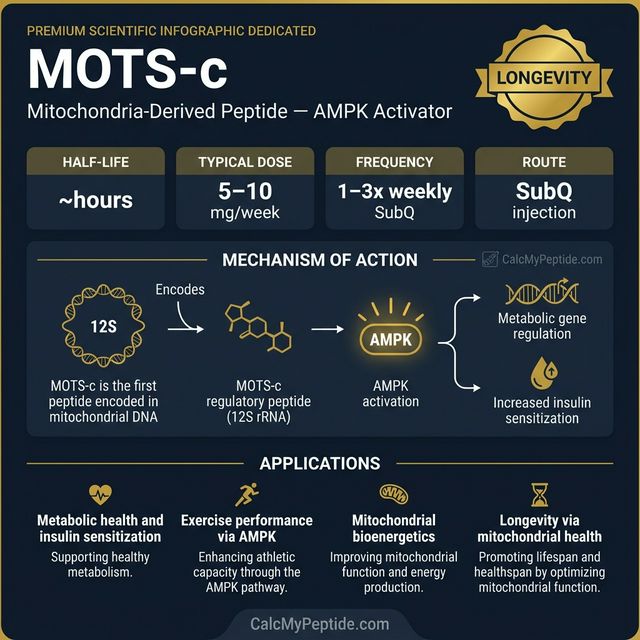
MOTS-c (Mitochondrial Open Reading Frame of the 12S rRNA Type-c) is a mitochondrial-derived peptide (MDP) — a signaling molecule encoded in the mitochondrial genome rather than the nuclear genome. It activates the AMPK pathway, the master metabolic regulator that enhances cellular energy metabolism, improves insulin sensitivity, and promotes glucose uptake in skeletal muscle.
MOTS-c represents a new class of signaling molecules called "mitokines" — mitochondrial hormones that communicate metabolic status from mitochondria to the nucleus and distant tissues. It has shown exercise-mimetic effects, improving metabolic health and physical performance in animal models.
Source: PMID: 25738459
📜Background & History
MOTS-c is a 16-amino-acid peptide encoded within the mitochondrial 12S rRNA gene, discovered by Changhan David Lee at USC in 2015 (Cell Metabolism). It was the first regulatory peptide found to be encoded in mitochondrial DNA rather than nuclear DNA — a paradigm shift in mitochondrial biology. MOTS-c acts as a retrograde signal from mitochondria to the nucleus, activating AMPK and regulating metabolic gene expression. Exercise increases circulating MOTS-c levels, suggesting it mediates some of the metabolic benefits of physical activity.
🎯 Research Use Cases
- ✓Metabolic health and insulin sensitization
- ✓Exercise performance enhancement via AMPK activation
- ✓Obesity and type 2 diabetes research protocols
- ✓Skeletal muscle function and age-related metabolic decline
- ✓Longevity: mitochondrial health and lifespan extension (preclinical)
💉 Dosing Protocol
| Typical Dose | 5-10 mg/week |
| Frequency | 3-5× weekly |
| Half-Life | ~4-6 hours (estimated) |
| Common Vial Sizes | 5 mg, 10 mg |
🧪 Reconstitution Example
⚠️Safety & Considerations
Research peptide. Limited human safety data — primarily studied in rodent models. Naturally occurring endogenous peptide in human mitochondria. May affect blood glucose — monitor if diabetic.
⚡Interactions & Contraindications
Research compound — limited human safety data. AMPK activation may interact with metformin (additive effects on glucose metabolism). Caution with insulin or GLP-1 agonists due to additive insulin sensitization. Available in injectable form; oral bioavailability very limited.
🔗Synergies & Common Stacks
Both are mitochondrial-derived peptides (MDPs) with overlapping cytoprotective effects. Humanin protects against apoptosis; MOTS-c enhances metabolic function. Often combined in mitochondrial health protocols.
NAD+ fuels mitochondrial function; MOTS-c activates the AMPK pathway downstream. Together they support comprehensive mitochondrial bioenergetics and metabolic resilience.
❓ Frequently Asked Questions
What does MOTS-c do?▼
How is MOTS-c dosed?▼
📖 References
- Reynolds JC, et al. “MOTS-c is an exercise-induced mitochondrial-encoded regulator of age-dependent physical decline.” Nat Commun (2021). PMID: 33479227
- Lee C, et al. “The mitochondrial-derived peptide MOTS-c promotes metabolic homeostasis.” Cell Metab (2015). PMID: 25738456