NAD+
Essential coenzyme found in all living cells, critical for energy metabolism, DNA repair, and sirtuin activation.
🔬 Mechanism of Action
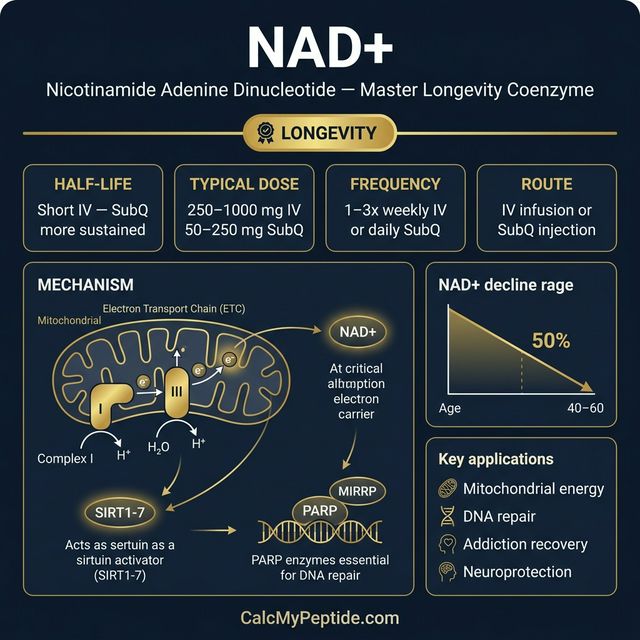
NAD+ (Nicotinamide Adenine Dinucleotide) is a coenzyme found in every living cell. It serves as a critical electron carrier in the mitochondrial electron transport chain (Complexes I and III), making it essential for ATP (energy) production.
Beyond energy metabolism, NAD+ is the required substrate for sirtuins (SIRT1-7), a family of enzymes involved in DNA repair, gene silencing, and longevity pathways. It is also consumed by PARPs (Poly ADP-Ribose Polymerases) during DNA damage repair. NAD+ levels decline ~50% between ages 40-60, contributing to metabolic dysfunction and aging.
Source: PMID: 29514064
📜Background & History
NAD+ (Nicotinamide Adenine Dinucleotide) is a coenzyme found in all living cells, central to energy metabolism and DNA repair via sirtuins and PARP enzymes. While not a peptide, it is frequently categorized alongside injectable therapeutic compounds. Its role in aging was established by David Sinclair at Harvard (2013, Cell), demonstrating NAD+ decline drives mitochondrial dysfunction and that restoration reverses aging hallmarks in mice. NAD+ IV therapy and NMN precursors have become the most widely used longevity interventions in anti-aging medicine.
🎯 Research Use Cases
- ✓Mitochondrial energy production and biogenesis
- ✓Sirtuin activation for DNA repair and epigenetic maintenance
- ✓Addiction recovery support (shown to reduce withdrawal symptoms)
- ✓Neurodegenerative disease protection via PARP and SIRT1
- ✓Exercise performance and recovery via ATP production support
💉 Dosing Protocol
| Typical Dose | 50-250 mg (SubQ) or 250-1000 mg (IV) |
| Frequency | 1-3× weekly |
| Half-Life | ~45 minutes (IV) |
| Common Vial Sizes | 100 mg, 500 mg |
🧪 Reconstitution Example
⚠️Safety & Considerations
Essential human coenzyme with generally excellent safety. IV administration may cause nausea and chest tightness if infused too rapidly. SubQ injection may cause injection site discomfort. Start with lower doses and titrate up.
⚡Interactions & Contraindications
IV NAD+ infusions can cause facial flushing, nausea, chest tightness at rapid infusion rates — always infuse slowly. PARP inhibitors (cancer drugs: olaparib, rucaparib) compete for NAD+ — do not combine with oncology treatment without oncologist input. Separate timing from alcohol (competes for NAD+ in metabolism).
🔗Synergies & Common Stacks
NAD+ powers mitochondrial NADH cycling; MOTS-c signals AMPK to improve metabolic efficiency. Together they comprehensively support mitochondrial health.
Epitalon restores telomere length; NAD+ supports the DNA repair machinery (PARP) that requires NAD+ as substrate. Synergistic longevity combination.
❓ Frequently Asked Questions
What is more effective — NAD+ IV or SubQ injection?▼
Why do NAD+ levels decline with age?▼
📖 References
- Canto C, et al. “NAD+ metabolism and the control of energy homeostasis.” Cell Metab (2015). PMID: 26166745
- Mills KF, et al. “Chronic NAD+ supplementation extends health span in mice.” Cell Metab (2016). PMID: 28068222