BPC-157 vs TB-500: Choosing the Right Recovery Peptide
BPC-157 and TB-500 are the two most popular research peptides for injury recovery and tissue repair. While they are often used together, they work through fundamentally different mechanisms and have distinct advantages depending on your specific recovery needs.
This guide breaks down every meaningful difference — mechanism, dosing, half-life, evidence base, and stacking — so you can make an informed decision.
Mechanism of Action: Head-to-Head
BPC-157 (Body Protection Compound-157) is a gastric pentadecapeptide that upregulates growth factor expression — specifically VEGF (Vascular Endothelial Growth Factor) and FGF (Fibroblast Growth Factor). This promotes angiogenesis (new blood vessel formation) and accelerates tendon-to-bone healing. It also modulates the nitric oxide (NO) system and has demonstrated neuroprotective effects.
TB-500 (Thymosin Beta-4) works through an entirely different pathway: actin regulation. It promotes actin polymerization, which enables cell migration to injury sites. TB-500 also stimulates angiogenesis and reduces inflammation systemically, but via cytoskeletal modulation rather than growth factor signaling.
Key distinction: BPC-157 is growth-factor-driven (localized healing). TB-500 is actin-driven (systemic healing). This is why they are synergistic when stacked.
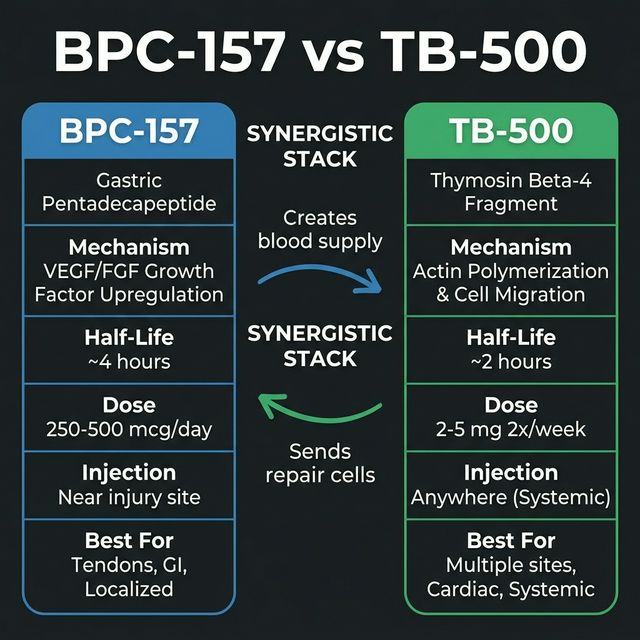
Comparison Table
| Property | BPC-157 | TB-500 |
|---|---|---|
| Origin | Gastric juice pentadecapeptide | Thymosin Beta-4 fragment |
| Primary Mechanism | VEGF/FGF upregulation | Actin polymerization |
| Half-Life | ~4 hours | ~2 hours (active metabolites longer) |
| Typical Dose | 250-500 mcg/day | 2-5 mg twice weekly |
| Injection Site | Near injury preferred | Anywhere (systemic) |
| Research Volume | 100+ studies | 50+ studies |
| Common Vial Size | 5 mg | 5 mg or 10 mg |
| Best For | Tendons, GI, localized injury | Systemic recovery, cardiac |
Dosing Protocols
BPC-157 Protocol: 250-500 mcg subcutaneously, 1-2× daily for 4-8 weeks. For a 5 mg vial reconstituted with 2 mL BAC water (2.5 mg/mL = 2,500 mcg/mL), each 10 units on a 100-unit syringe = 250 mcg.
TB-500 Protocol: Loading phase — 2-5 mg twice weekly for 4-6 weeks. Maintenance — 2 mg once weekly. For a 5 mg vial reconstituted with 2 mL BAC water (2.5 mg/mL), draw 80 units on a 100-unit syringe for a 2 mg dose.
Use our Reconstitution Calculator for precise syringe units based on your specific vial and dose.
The BPC-157 + TB-500 Stack
The BPC-157 + TB-500 combination is the most popular recovery peptide stack. They work through complementary mechanisms:
• BPC-157 provides growth-factor-driven localized healing — targeting the specific injury site with enhanced blood vessel formation.
• TB-500 provides actin-driven systemic healing — enabling cell migration throughout the body to find and repair damage.
Stack Protocol: Run BPC-157 at 250-500 mcg daily alongside TB-500 at 2-5 mg twice weekly. Many users keep both peptides in separate vials and inject from each. Use our Blend/Stack Calculator for combined dose calculations.
The synergy: BPC-157 creates the blood supply (angiogenesis) while TB-500 sends repair cells (cell migration). Together, they address both halves of the healing equation.
When to Choose Each Peptide
Choose BPC-157 when: You have a specific, localized injury (tendon, ligament, muscle). You want to inject near the injury site. You have GI issues alongside musculoskeletal injury (BPC-157 protects gastric mucosa).
Choose TB-500 when: You have multiple injury sites or systemic inflammation. You prefer less frequent injections (2× weekly vs daily). You have cardiac concerns (TB-500 has cardioprotective data).
Choose the stack when: You want maximum recovery speed. You have a significant injury requiring both localized and systemic support. Budget allows for both peptides.