What Is GHK-Cu?
GHK-Cu (Glycyl-L-Histidyl-L-Lysine copper complex, also written GHK-Cu²⁺) is a naturally occurring tripeptide-copper complex first isolated from human plasma by Dr. Loren Pickart in 1973. It is one of the most studied peptides in regenerative and aesthetic medicine. GHK-Cu naturally occurs in human plasma, saliva, and urine, with blood concentrations highest in young adults (~200 ng/mL at age 20) and declining significantly with age (~80 ng/mL by age 60). Pickart identified a correlation between these declining GHK-Cu levels and the decline in wound healing capacity observed in aging (Pickart L et al., Biomed Res Int, 2015, PMID: 25861634). CalcMyPeptide provides a free reconstitution calculator for GHK-Cu and all aesthetic peptides.
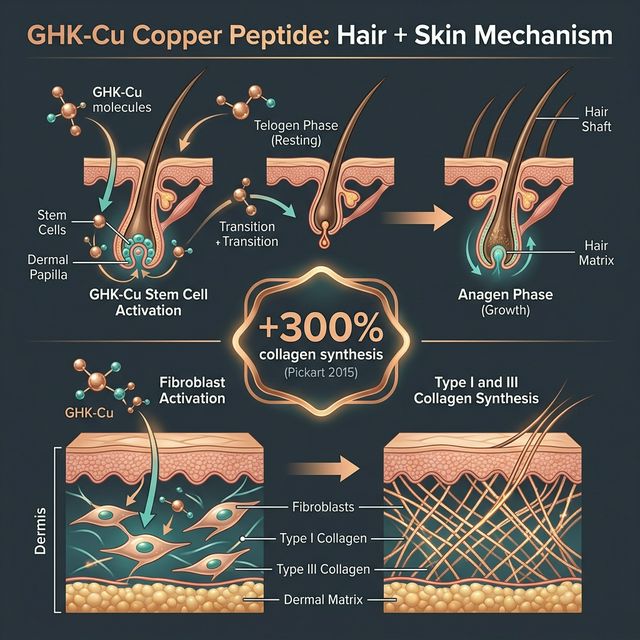
GHK-Cu activates at least 31 genes associated with collagen synthesis and 8 anti-aging genes, making it one of the most transcriptionally active peptides studied. It acts through multiple mechanisms: fibroblast activation, stem cell stimulation (hair follicle), antioxidant defense, DNA repair signaling, and matrix metalloproteinase (MMP) regulation.
How Does GHK-Cu Stimulate Hair Growth?
GHK-Cu promotes hair growth through several mechanisms:
1. Follicle stem cell activation: GHK-Cu stimulates stem cells in the hair follicle bulge region, promoting the transition from the telogen (resting) phase to the anagen (active growth) phase. This is the same transition targeted by minoxidil, but through a different pathway.
2. 5-alpha reductase inhibition: GHK-Cu has mild inhibitory activity against 5-alpha reductase — the enzyme that converts testosterone to DHT (dihydrotestosterone). DHT is the primary driver of androgenetic alopecia (pattern hair loss). This is the same mechanism as finasteride, though less potent.
3. Improved follicle vascularity: Through VEGF upregulation (shared with BPC-157), GHK-Cu promotes angiogenesis around hair follicles, improving nutrient and oxygen delivery.
4. Anti-oxidant protection: Hair follicle miniaturization in androgenetic alopecia is associated with oxidative stress. GHK-Cu's antioxidant effects may protect follicle integrity.
Philips N et al. (Connect Tissue Res, 2001, PMID: 11569756) demonstrated copper peptide-mediated hair growth promotion through 5-alpha reductase inhibition, establishing the mechanistic basis for GHK-Cu in hair loss treatment.
GHK-Cu for Skin: Collagen Synthesis and Wound Healing
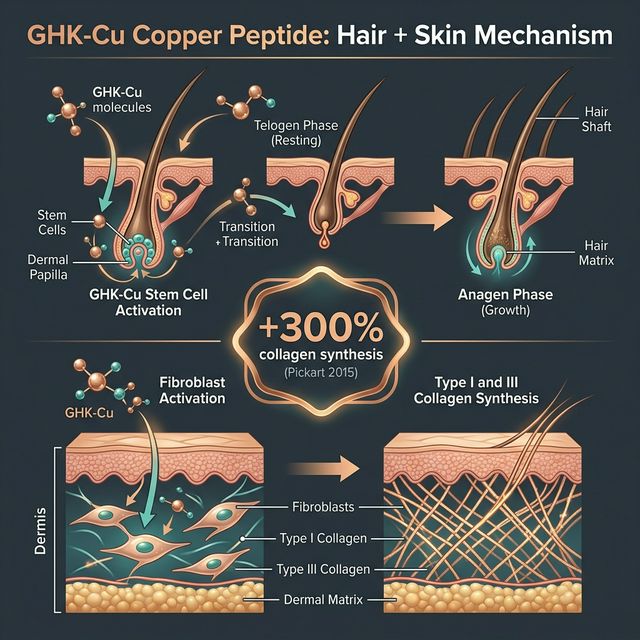
GHK-Cu is one of the most potent naturally occurring collagen stimulators studied. In fibroblasts, it activates genes encoding Type I and Type III collagen, elastin, fibronectin, and collagen-binding integrins — the full mechanical scaffold of healthy skin. Pickart L et al. (2015) showed that GHK-Cu activates 31 pro-collagen genes and represses 14 genes associated with collagen degradation, creating a strongly anabolic environment for connective tissue.
Wound healing acceleration: GHK-Cu contracts wound margins, stimulates epithelialization (skin cell migration to cover wounds), and promotes angiogenesis — all documented in Cangul IT et al. (Vet Dermatol, 2004, PMID: 15101415), who showed significant wound healing acceleration in dogs treated with copper tripeptide versus placebo.
Anti-aging effects: GHK-Cu reverses the gene expression data signature of aged skin to resemble younger tissue — it down-regulates genes associated with inflammation and oxidative stress while up-regulating repair and structural genes.
GHK-Cu Dosing and Delivery Methods
GHK-Cu can be delivered both topically and by injection:
| Route | Dose | Frequency | Notes |
|---|---|---|---|
| SubQ injection | 500 mcg–1 mg | 3–5x/week | Systemic; most studied route |
| Topical | 1–5% concentration | Daily | Limited systemic absorption; localized skin effect |
| Mesotherapy | 100–500 mcg | 1–2x/week | Microinjection into dermis; hair or wrinkle protocols |
Reconstitution for 10 mg GHK-Cu vial with 2 mL BAC water: concentration = 5 mg/mL = 5,000 mcg/mL. On a U-100 syringe, each unit delivers 50 mcg. For 500 mcg dose: draw 10 units. Use CalcMyPeptide for any vial configuration.
Topical GHK-Cu: widely available in skin serums (0.1–5%). Injectable requires reconstitution from lyophilized supply. Injectable delivers systemic and scalp-specific effects simultaneously.
Clinical Evidence for GHK-Cu
GHK-Cu has one of the longer research histories among aesthetic peptides:
• Pickart L et al. (Biomed Res Int, 2015): comprehensive review showing GHK-Cu activates 31 collagen genes, 8 anti-aging genes; represses 14 collagen-degrading genes; modulates 2,890 human gene sets relevant to skin biology
• Cangul IT et al. (Vet Dermatol, 2004): copper tripeptide significantly accelerated wound healing vs control; measured by wound contraction and histology
• Philips N et al. (Connect Tissue Res, 2001): copper peptide promoted hair growth through 5-alpha reductase inhibition and collagen fibrillogenesis
No human RCTs for injectable GHK-Cu specifically for hair growth or systemic anti-aging have been published as of 2026. Topical studies show improved skin firmness and wound healing, with injectable evidence extrapolated from animal and in vitro data.
How Does GHK-Cu Signal Collagen Synthesis?
GHK-Cu binds to cell surface proteoglycans and enters cells via receptor-mediated endocytosis. Inside the cell, it activates the Wnt/β-catenin pathway — a master signaling cascade that simultaneously stimulates collagen gene expression (COL1A1, COL1A2, COL3A1) and promotes stem cell proliferation. It also activates TGF-β1 pathways (transforming growth factor-beta 1), the primary driver of collagen synthesis in fibroblasts. The copper ion plays a critical role as a cofactor for lysyl oxidase, the enzyme that crosslinks collagen and elastin fibers to form mechanically strong connective tissue.
Does GHK-Cu Work Topically or Only by Injection?
Both routes are active, but for different targets. Topical GHK-Cu (1–5% serums) works for superficial skin improvements — improved firmness, texture, fine lines — but penetration is limited to the epidermis and upper dermis. Injectable GHK-Cu reaches the deep dermis systemically, supports hair follicle activity through scalp vascularity, and may have body-wide collagen benefits. Mesotherapy protocols (microinjections into the dermis) combine aspects of both: localized high concentration without the systemic distribution of SubQ injection. Most clinical-grade aesthetic protocols combine topical application (daily) with periodic injection for additive effect.
How Long Does It Take to See Hair Growth with GHK-Cu?
Based on the hair cycle biology: the anagen phase, once triggered, lasts 2–6 years (individual variation). But initiating the anagen phase from telogen takes 4–8 weeks of continuous stem cell stimulation. Most GHK-Cu hair growth protocols report initial shedding (telogen effluvium) at 4–6 weeks as resting hairs are pushed out to make way for new anagen growth — consistent with hair cycling acceleration. Visible new growth is typically reported at 8–12 weeks. Complete assessment of hair growth response requires 4–6 months of consistent use, following the same timeline as minoxidil and similar agents. For hair-specific protocols, combine SubQ or mesotherapy GHK-Cu with daily topical application. For dosing math, use the CalcMyPeptide free reconstitution calculator.