Peptide Injection Master Guide: SubQ & IM Techniques, Site Maps, and Safety
Step-by-step guide to subcutaneous and intramuscular peptide injections with injection site body maps, needle gauge selection, rotation protocols, and common mistake prevention.
Key Takeaways
- ✓SubQ (subcutaneous) is the standard route for most peptides — inject into fatty tissue at 45-90°
- ✓The abdominal "Golden Zone" (2 inches from navel) offers the best absorption for SubQ injections
- ✓Use 29-31G needles for SubQ (thinner = less pain). 27G for IM injections
- ✓Always rotate injection sites to prevent scar tissue (lipohypertrophy)
- ✓Never reuse needles — one syringe per injection, dispose in a sharps container
⚕️ Medical Disclaimer: This guide is for educational purposes only. Always consult a licensed healthcare provider before starting any injection protocol. If you experience severe pain, swelling, signs of infection, or allergic reaction, seek medical attention immediately.
1. Why Proper Injection Technique Matters
Injection technique directly affects three critical outcomes: absorption rate (how quickly and completely the peptide enters your bloodstream), comfort (pain and bruising), and safety (infection risk and tissue damage).
Poor technique can lead to inconsistent dosing — injecting too deep (into muscle when you intended SubQ) changes the absorption profile. Injecting too shallow (into the dermis) causes painful welts. Reusing needles introduces bacteria and dulls the tip, causing more tissue trauma.
💉
Absorption
Correct depth ensures the peptide reaches the intended tissue layer for optimal pharmacokinetics
🛡️
Safety
Sterile technique prevents infection. Site rotation prevents scar tissue that reduces absorption over time
📏
Accuracy
Proper syringe handling avoids air bubbles and ensures the full calculated dose is delivered
2. SubQ vs IM: Which Method for Which Peptide
The two primary injection routes for peptides are subcutaneous (SubQ) — into the fatty tissue just below the skin — and intramuscular (IM) — deep into the muscle. The choice depends on the peptide, volume, and desired absorption rate.
Subcutaneous (SubQ)
- • Depth: Fatty tissue layer (2-10mm below skin)
- • Angle: 45° (lean individuals) or 90° (pinched skin fold)
- • Needle: 29-31G, 5/16" to 1/2"
- • Absorption: Slow, sustained release
- • Best for: BPC-157, TB-500, semaglutide, tirzepatide, GH peptides, most research peptides
- • Volume limit: ≤1 mL per site
Intramuscular (IM)
- • Depth: Deep into muscle tissue
- • Angle: 90° (straight in)
- • Needle: 25-27G, 1" to 1.5"
- • Absorption: Faster than SubQ
- • Best for: Testosterone, B12, some larger-volume compounds
- • Volume limit: ≤3 mL (deltoid ≤1 mL)
💡 Pro Tip: For 90%+ of peptide users, SubQ is the correct method. IM is only used for specific compounds that require faster absorption or are administered in larger volumes. When in doubt, SubQ is the default.
3. Injection Site Maps
SubQ Injection Sites
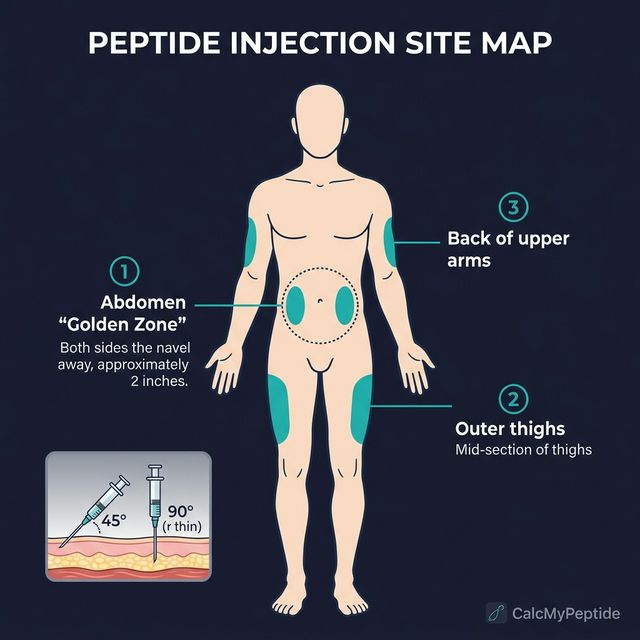
Abdomen — "The Golden Zone"
The area 2 inches (5cm) away from the belly button on either side. Most popular site for peptide injections due to consistent fat layer and excellent absorption.
- • Avoid the area directly around the navel (2-inch radius)
- • Rotate between left/right and upper/lower quadrants
- • The most reliable site for consistent absorption
Outer Thigh (Vastus Lateralis)
The outer middle third of the thigh. Good alternative when abdomen is sore or for rotation.
- • Target the outer portion — avoid inner thigh (more nerve endings)
- • Halfway between knee and hip
- • Lean individuals should pinch fat before injecting
Back of Upper Arm (Triceps area)
The fatty area on the back of the upper arm. Harder to self-inject; may need assistance.
- • Use if abdomen and thigh sites need rest
- • Self-injection is possible but awkward — a partner can help
- • Good absorption but less subcutaneous fat than abdomen
IM Injection Sites
Deltoid (Shoulder)
The thick part of the shoulder muscle. Best for small-volume IM injections (≤1 mL).
- • 2-3 finger widths below the acromion process
- • Most accessible site for self-injection IM
Vastus Lateralis (Outer Thigh)
The large outer thigh muscle. Accommodates larger volumes (up to 3 mL).
- • Divide thigh into thirds — inject into middle third
- • Sit on edge of chair with leg relaxed
Ventrogluteal (Hip)
The safest IM site — fewest blood vessels and nerves. Requires a partner to inject.
- • Located on the side of the hip, above the greater trochanter
- • Preferred site in clinical settings for IM injections
4. Needle Gauge & Length Selection
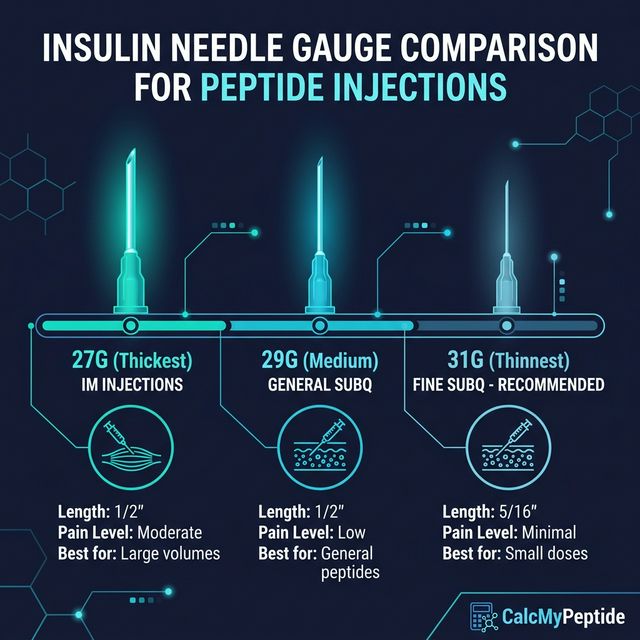
"Gauge" (G) measures needle thickness — higher gauge = thinner needle. For subcutaneous peptide injections, thinner needles (29-31G) cause less pain and are sufficient since the injection depth is shallow.
| Gauge | Length | Route | Pain Level | Best For |
|---|---|---|---|---|
| 31G | 5/16" (8mm) | SubQ only | ★☆☆ Minimal | Low-volume peptides (BPC-157, semaglutide) |
| 30G | 5/16" (8mm) | SubQ only | ★☆☆ Minimal | Standard insulin syringes (0.3-0.5 mL) |
| 29G | 1/2" (12.7mm) | SubQ | ★★☆ Low | Larger volumes, standard 1 mL insulin syringe |
| 27G | 1/2" (12.7mm) | SubQ / IM (lean) | ★★☆ Low | IM injections in deltoid, reconstitution drawing |
| 25G | 1" (25mm) | IM | ★★★ Moderate | Deep IM into larger muscles (thigh, glute) |
| 23G | 1.5" (38mm) | IM | ★★★ Moderate | Thick substances (oil-based), large-volume IM |
5. Step-by-Step SubQ Injection Protocol
- 1
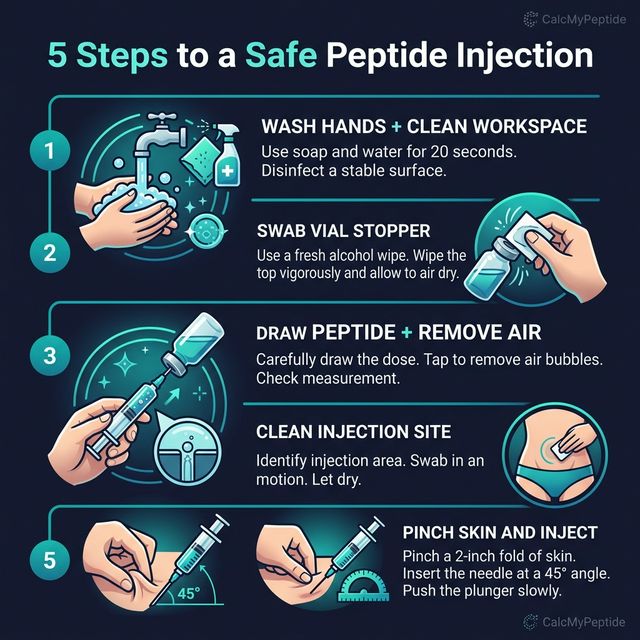
Prepare Your Workspace
Wash hands thoroughly with soap for 20+ seconds. Lay out: peptide vial, insulin syringe, alcohol swabs, sharps container. Work on a clean, flat, well-lit surface.
- 2
Swab the Vial Stopper
Remove the plastic flip-cap from the vial. Wipe the rubber stopper with a fresh alcohol swab in a single circular motion from center outward. Let dry for 10 seconds — injecting through wet alcohol stings.
- 3
Draw the Peptide
Pull the syringe plunger to your dose volume, drawing in air. Insert the needle through the center of the rubber stopper and inject the air (equalizes pressure). Invert the vial and slowly draw your calculated number of units. Remove air bubbles by gently flicking the syringe barrel, then push the plunger to expel them.
- 4
Prepare the Injection Site
Choose your site (abdomen preferred). Clean a 2-inch area with a fresh alcohol swab in a circular motion from center outward. Let dry completely — injecting through wet alcohol causes stinging.
- 5
Pinch and Inject
Pinch a 1-2 inch fold of skin between thumb and forefinger. Insert the needle at a 45° angle (or 90° if significant fat layer) in a quick, dart-like motion. Release the skin fold. Push the plunger slowly and steadily — rushing causes more tissue trauma.
- 6
Withdraw and Dispose
Pull the needle out at the same angle it went in. Do NOT rub the injection site (increases bruising) — you can apply gentle pressure with a clean cotton ball for 10 seconds if needed. Immediately dispose of the syringe in a sharps container. Never recap a used needle.
6. Step-by-Step IM Injection Protocol
IM injections follow a similar process but with key differences in needle selection, angle, and technique:
- 1
Select Equipment
Use a 25-27G needle, 1-1.5 inches long. For drawing thick solutions, use a larger bore needle (21G) to draw, then switch to the injection needle — this preserves sharpness.
- 2
Locate the Injection Site
For deltoid: 2-3 finger widths below the acromion (bony point of shoulder). For vastus lateralis: outer middle third of thigh. For ventrogluteal: side of hip above greater trochanter.
- 3
Clean and Position
Swab the site. Stretch the skin taut (do NOT pinch for IM). This separates the skin from the muscle and creates a straighter needle path.
- 4
Inject at 90°
Insert the needle straight in at a 90° angle in one quick motion. Aspirate briefly (pull back on plunger) — if blood appears, withdraw and try a new site. If clear, inject slowly.
- 5
Withdraw and Apply Pressure
Remove the needle smoothly. Apply firm pressure with a cotton ball or gauze for 30-60 seconds. A bandage may be applied if oozing occurs.
7. Common Mistakes & How to Avoid Them
❌ Reusing needles
✅ One syringe per injection
Used needles are dulled, barbed at the tip, and contaminated with bacteria. Reuse causes more tissue damage, pain, and infection risk.
❌ Rubbing the injection site
✅ Apply gentle pressure only
Rubbing disperses the peptide from the injection depot and increases bruising. Light pressure with a cotton ball is fine.
❌ Injecting into the same spot
✅ Rotate sites systematically
Repeated injections at the same spot cause lipohypertrophy (hardened fatty lumps) that reduce peptide absorption by 10-25%.
❌ Injecting through wet alcohol
✅ Wait 10 seconds to dry
Alcohol entering the injection track causes a painful stinging sensation and can irritate subcutaneous tissue.
❌ Shaking the vial to mix
✅ Swirl gently
Shaking denatures peptide molecules by creating foam and shear forces. Gently swirl or roll the vial between your palms.
❌ Pushing the plunger too fast
✅ Inject slowly over 5-10 seconds
Rapid injection creates tissue trauma and increases post-injection pain. Slow, steady injection distributes the solution evenly.
❌ Not removing air bubbles
✅ Flick barrel and expel air
Small air bubbles are harmless in SubQ injection but reduce dose accuracy. Remove them for precise dosing.
8. Injection Site Rotation Schedule
Site rotation prevents lipohypertrophy (hardened tissue) and ensures consistent absorption. Use a systematic pattern and wait at least 1 inch (2.5 cm) between injection points within the same site.
7-Day Rotation Example (Daily Injections)
Mon
Abdomen L-Upper
Tue
Abdomen R-Upper
Wed
L Thigh
Thu
Abdomen L-Lower
Fri
Abdomen R-Lower
Sat
R Thigh
Sun
L or R Arm
Weekly Injection Rotation (GLP-1, once/week)
Week 1
Abdomen Left
Week 2
Abdomen Right
Week 3
Left Thigh
Week 4
Right Thigh
9. Post-Injection Care & When to Seek Help
✅ Normal (No Action Needed)
- • Small red dot at injection site
- • Minor bruising (resolves in 3-5 days)
- • Mild stinging for 10-30 seconds
- • Tiny droplet of blood after withdrawal
- • Small subcutaneous welt (absorbed in 1-2 hours)
🚨 Seek Medical Attention
- • Spreading redness, warmth, or streaks from site
- • Pus or discharge from injection site
- • Fever following injection
- • Severe swelling or hives (allergic reaction)
- • Persistent pain lasting more than 48 hours
- • Hard lump at site that doesn't resolve in 1 week
10. Frequently Asked Questions
Does the injection hurt?
Can I inject two peptides at the same site?
What if I see blood in the syringe after inserting?
How do I dispose of used needles safely?
Can I inject through clothing in an emergency?
Is it normal to have a bump after SubQ injection?
Should I warm the peptide before injecting?
Calculate Your Exact Dose
Now that you know the technique, calculate exactly how many units to draw for your peptide.
Open Reconstitution CalculatorQuestions or corrections? Contact us at contact@calcmypeptide.com.
📖 References
- WHO Injection Safety Guidelines. “Safe injection practices for subcutaneous peptide administration.” WHO Technical Report (2016).
🧪 Try the Calculator
Put this knowledge into practice — calculate your exact concentration and syringe units for free.
Open Reconstitution Calculator →