Gonadorelin
Bioidentical gonadotropin-releasing hormone commonly prescribed alongside TRT to maintain fertility and testicular function.
🔬 Mechanism of Action
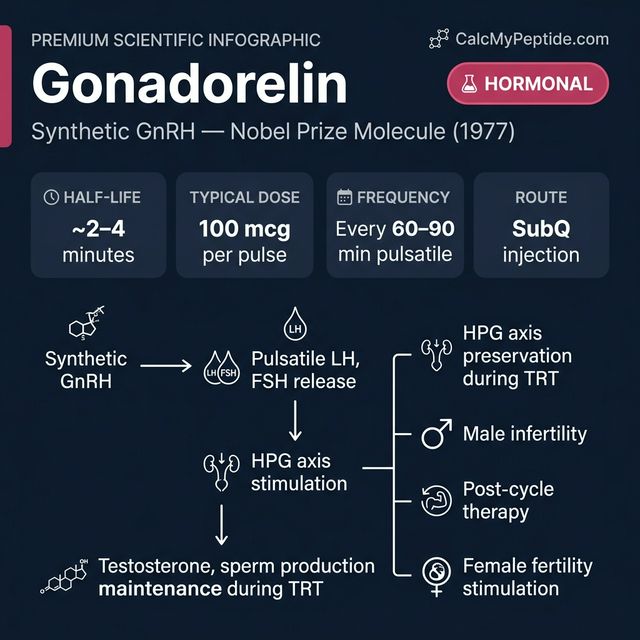
Gonadorelin is a bioidentical synthetic version of the naturally occurring gonadotropin-releasing hormone (GnRH/LHRH). It is a decapeptide that acts on the anterior pituitary gonadotroph cells to stimulate release of both luteinizing hormone (LH) and follicle-stimulating hormone (FSH).
In pulsatile administration, gonadorelin maintains and restores the hypothalamic-pituitary-gonadal (HPG) axis. It is commonly prescribed alongside testosterone replacement therapy (TRT) to preserve fertility and testicular function. Continuous (non-pulsatile) administration paradoxically suppresses LH/FSH — this is exploited by GnRH agonists like leuprolide.
Source: PMID: 1903034
📜Background & History
Gonadorelin is the synthetic form of endogenous GnRH (Gonadotropin-Releasing Hormone), a decapeptide produced in the hypothalamus that drives pulsatile release of LH and FSH from the pituitary. It was first synthesized and characterized by Andrew Schally and Roger Guillemin in 1971, earning them the 1977 Nobel Prize in Physiology or Medicine. Pulsatile gonadorelin maintains testicular function and testosterone production during androgen therapy by preserving the HPG axis — specifically preventing the testicular atrophy and infertility caused by exogenous testosterone.
🎯 Research Use Cases
- ✓HPG axis preservation during testosterone replacement therapy (TRT)
- ✓Male infertility treatment via LH/FSH stimulation
- ✓Post-cycle therapy (PCT) to restore natural testosterone production
- ✓Female fertility stimulation in hypothalamic amenorrhea
💉 Dosing Protocol
| Typical Dose | 100-500 mcg/day |
| Frequency | 1-2× daily |
| Half-Life | ~4 minutes |
| Common Vial Sizes | 2 mg |
🧪 Reconstitution Example
⚠️Safety & Considerations
FDA-approved (Factrel) for diagnostic use. Well-established safety profile. Must be administered in pulsatile fashion to maintain gonadal function — continuous use will suppress LH/FSH. Injection site irritation is the most common side effect.
⚡Interactions & Contraindications
Pulsatile administration (every 60-90 min) is required for efficacy — continuous infusion paradoxically suppresses LH/FSH (basis of GnRH agonist therapy for prostate cancer). Depot formulations of GnRH agonists (leuprolide, histrelin) work by this paradoxical suppression mechanism. Antiandrogens blunt downstream testosterone response.
🔗Synergies & Common Stacks
Kisspeptin acts upstream of GnRH — it's the master activator of GnRH neurons. Combining both ensures complete HPG axis stimulation from hypothalamic to pituitary to gonadal level.
❓ Frequently Asked Questions
Why is gonadorelin used with TRT?▼
How often should gonadorelin be injected?▼
📖 References
- Al-Inany HG, et al. “GnRH agonist and antagonist treatment protocols for assisted reproduction.” Cochrane Database Syst Rev (2016). PMID: 27126581