Pinealon
Khavinson bioregulator tripeptide with neuroprotective and geroprotective properties; modulates pineal gland function and melatonin synthesis.
🔬 Mechanism of Action
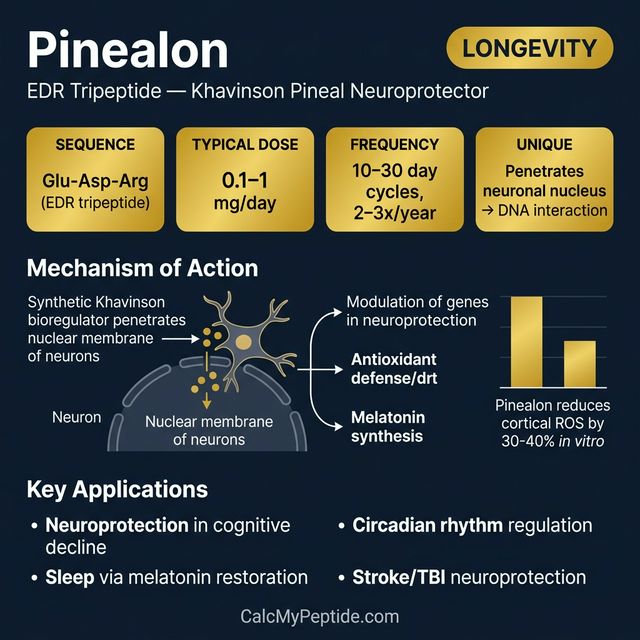
Pinealon (Glu-Asp-Arg, EDR) is a synthetic tripeptide bioregulator developed by Vladimir Khavinson at the Saint Petersburg Institute of Bioregulation and Gerontology. It specifically targets central nervous system tissues, particularly the pineal gland and cortical neurons.
Pinealon penetrates the nuclear membrane of neuronal cells and interacts directly with DNA, modulating gene expression related to neuroprotection, antioxidant defense, and melatonin synthesis. In vitro studies demonstrate that Pinealon reduces markers of oxidative stress (reactive oxygen species) in cortical neuron cultures by 30-40%.
As a pineal gland bioregulator, it normalizes melatonin production — which naturally declines with age — supporting circadian rhythm regulation, sleep quality, and the endogenous antioxidant cascade that melatonin drives. Khavinson's research group has published over 30 papers on short peptide bioregulators, demonstrating their ability to regulate gene expression epigenetically.
Source: PMID: 18402693
📜Background & History
Pinealon (Glu-Asp-Arg, EDR) is a synthetic tripeptide bioregulator developed by Vladimir Khavinson at the Saint Petersburg Institute of Bioregulation and Gerontology. It specifically targets central nervous system tissues, particularly pineal gland and cortical neurons. Unlike most neuropeptides, Pinealon penetrates the nuclear membrane of neuronal cells and interacts directly with DNA, modulating gene expression related to neuroprotection, antioxidant defense, and melatonin synthesis. Over 30 peer-reviewed publications from Khavinson's group document its effects.
🎯 Research Use Cases
- ✓Neuroprotection in age-related cognitive decline and dementia
- ✓Sleep quality improvement via melatonin production restoration
- ✓Circadian rhythm normalization (shift workers, jet lag)
- ✓Antioxidant defense in cortical neurons (reduces ROS by 30-40% in vitro)
- ✓Stroke and TBI neuroprotection (animal models)
💉 Dosing Protocol
| Typical Dose | 10-20 mg/day (oral/nasal) or 1-2 mg SC |
| Frequency | 1× daily for 10-30 day cycles |
| Half-Life | ~30 minutes (estimated) |
| Common Vial Sizes | 5 mg, 10 mg |
🧪 Reconstitution Example
⚠️Safety & Considerations
Pinealon has been used in Russian clinical practice for over a decade with a favorable safety profile. Available as oral capsules, nasal drops, or subcutaneous injection. Cycle-based dosing (10-30 days) is standard Khavinson protocol. Not FDA-approved. May potentiate sedative effects due to melatonin pathway modulation. Avoid combining with melatonin supplements without medical guidance.
⚡Interactions & Contraindications
May potentiate sedative/melatonin effects — avoid combining with melatonin supplements (additive pineal stimulation). Standard Khavinson protocol: 10-30 day cycles, 2-3 cycles per year. No significant drug interactions documented in published research. Available in oral, nasal, or injectable forms.
🔗Synergies & Common Stacks
Both are Khavinson pineal bioregulators — Epitalon restores telomerase and melatonin secretory capacity; Pinealon protects neuronal DNA. Often used in sequence: Epitalon for longevity, Pinealon for cognitive and sleep support.
Semax provides exogenous BDNF/NGF signaling; Pinealon protects the neurons from oxidative damage. Complementary neuroprotective-nootropic stack.
❓ Frequently Asked Questions
What is the difference between Pinealon and Epitalon?▼
How is Pinealon administered?▼
Does Pinealon improve sleep?▼
📖 References
- Khavinson VK, et al. “Peptide regulation of gene expression and protein synthesis in bronchial epithelium.” Bull Exp Biol Med (2008). PMID: 18402693
- Khavinson VK, et al. “Short peptides modulate the effect of endonucleases of wheat seedling.” Bull Exp Biol Med (2010). PMID: 21516878
- Khavinson VK, et al. “Neuroprotective effect of EDR peptide in models of oxidative stress.” Bull Exp Biol Med (2012). PMID: 22803090