⚕️ Medical Disclaimer
**⚕️ Medical Disclaimer:** This article is for educational and informational purposes only. It does not constitute medical advice. Consult a qualified healthcare provider before using any peptide.
Why Peptides for Joint Pain? The Case Beyond NSAIDs
Joint pain — particularly knee osteoarthritis, tendinopathy, and cartilage degeneration — is one of the most common reasons people explore peptide therapy. And for good reason: the standard approach (NSAIDs, corticosteroid injections, and eventually surgery) manages symptoms without addressing the underlying tissue degradation.
*Last updated: March 2026*
Peptides like BPC-157, TB-500, and GHK-Cu target the repair machinery itself: angiogenesis, collagen synthesis, cell migration, and anti-inflammatory signaling. They do not mask pain — they (theoretically, based on preclinical evidence) accelerate the biological processes that heal the tissue causing the pain.
This guide covers which peptides target which joint structures, the evidence base for each, practical dosing protocols, and how to stack them for maximum recovery. For the foundational reconstitution math, use our Reconstitution Calculator.
Which Peptides Target Joint Structures?
| Peptide | Primary Joint Target | Mechanism | Best For | Evidence Level |
|---|---|---|---|---|
| BPC-157 | Tendons, ligaments, synovial lining | Angiogenesis, VEGF upregulation, GH receptor expression | Tendinopathy, ligament sprains, post-surgical healing | Strong preclinical; limited clinical |
| TB-500 | Systemic tissue repair, cartilage | Actin upregulation, cell migration, anti-fibrosis | Chronic injuries, muscle-tendon junction, systemic repair | Strong preclinical; limited clinical |
| GHK-Cu | Collagen matrix, cartilage surface | Collagen I/III synthesis, MMP inhibition, anti-inflammatory | Cartilage preservation, skin/joint aging | Moderate preclinical + human skin data |
| Pentosan polysulfate (PPS) | Cartilage, synovial fluid | GAG replacement, anti-inflammatory | Osteoarthritis (veterinary and human use) | FDA-approved for bladder; off-label joint use |
| Thymosin alpha-1 | Immune modulation | Dendritic cell activation, immune regulation | Autoimmune-driven joint inflammation (RA) | Approved in 30+ countries for immune modulation |
The standout combination for most users: **BPC-157 for local tendon/ligament repair + TB-500 for systemic healing + GHK-Cu for collagen preservation.** This three-peptide approach targets different layers of joint architecture simultaneously.
BPC-157 for Tendon and Ligament Repair
**BPC-157 is the most studied peptide for tendon healing.** In preclinical models, BPC-157 accelerated Achilles tendon repair, MCL (medial collateral ligament) healing, and rotator cuff recovery through VEGF-mediated angiogenesis and upregulation of growth hormone receptors in injured tissue (Chang et al., 2011, PMID: 21030672).
**Joint-specific protocol:**
• Dose: 250-500 mcg SubQ, 2x daily
• Injection site: as close to the affected joint as practically accessible via SubQ (e.g., medial or lateral knee for knee injuries)
• Duration: 4-8 weeks
• Oral option: Oral BPC-157 (500 mcg, 2x daily) provides systemic recovery with lower bioavailability but no injection requirement
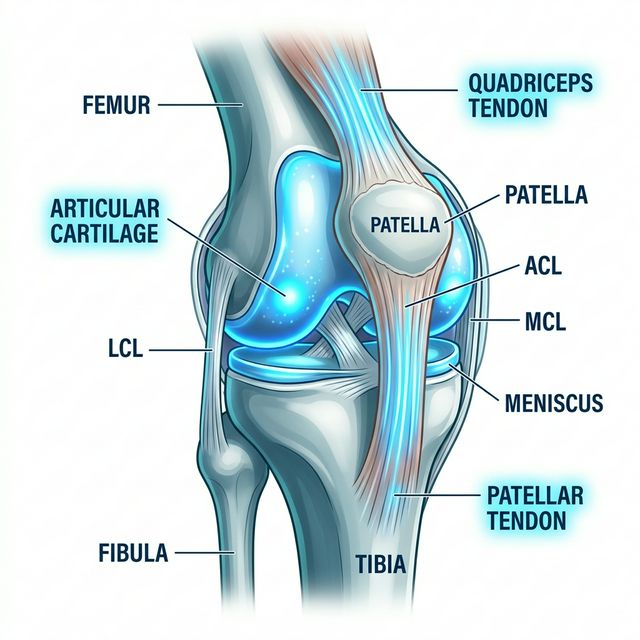
BPC-157 has particular relevance for knee ACL and meniscus injuries because it promotes tendon-to-bone healing at the attachment point — a notoriously slow healing zone. The gastroprotective properties also make it useful for athletes taking NSAIDs for pain management alongside the peptide protocol.
TB-500 for Systemic Joint Recovery
**TB-500 works systemically — it does not need to be injected near the joint to deliver benefits.** Its actin-upregulating mechanism promotes cell migration site-independently, making it ideal for diffuse joint conditions (multiple joint involvement) or injuries in hard-to-inject locations.
**Joint-specific protocol:**
• Loading: 2-2.5 mg SubQ, 2x per week for 4-6 weeks
• Maintenance: 2-2.5 mg SubQ, 1x per week for 4-8 additional weeks
• Injection site: any convenient SubQ location (abdomen is standard)
TB-500 is particularly effective for muscle-tendon junction injuries and chronic tendinopathy that has not responded to rest alone. It also promotes angiogenesis in avascular tissues (like cartilage, which has no direct blood supply), potentially improving nutrient delivery to the joint surface.
For full TB-500 protocols, read our TB-500 dosage guide. Stack with BPC-157 for the combined protocol described in our peptide stacking guide.
GHK-Cu for Cartilage and Collagen Preservation
**GHK-Cu (copper peptide) supports cartilage maintenance through three mechanisms: stimulating collagen I and III synthesis, inhibiting MMPs (matrix metalloproteinases) that break down cartilage, and reducing inflammatory IL-6 signaling** (Pickart et al., 2015, PMID: 25815988).
While GHK-Cu is more commonly discussed for skin and hair (see our GHK-Cu hair growth guide), the same collagen-building mechanism applies to articular cartilage, tendons, and the joint capsule.
**Joint-support protocol:**
• Dose: 1-2 mg SubQ, 1x daily or every other day
• Duration: 8-12 weeks (collagen synthesis is a slow process)
• Note: GHK-Cu can also be applied topically to superficial joints (fingers, toes, knee surface) via cream formulation, though SubQ provides superior systemic bioavailability
GHK-Cu is the "long game" peptide in a joint recovery stack. While BPC-157 and TB-500 address acute repair, GHK-Cu focuses on maintaining and rebuilding the collagen matrix that prevents future degeneration.
Joint Recovery Stack: Putting It All Together
**The triple-peptide joint recovery stack is the most comprehensive protocol for cartilage and joint repair:**
| Peptide | Dose | Frequency | Injection Site | Role in Stack |
|---|---|---|---|---|
| BPC-157 | 250-500 mcg SubQ | 2x daily | Near affected joint | Local tendon/ligament repair |
| TB-500 | 2-2.5 mg SubQ | 2x/week (loading), 1x/week (maintenance) | Any SubQ site | Systemic tissue repair, cell migration |
| GHK-Cu | 1-2 mg SubQ | Daily or EOD | Any SubQ site | Collagen preservation, anti-inflammatory |
**Protocol duration:** 8-12 weeks minimum for chronic joint conditions. Reassess at 6 weeks with subjective pain scores and (if available) imaging.
Use our Blend/Stack Calculator for reconstitution math when running multiple peptides, and track your protocol with a peptide tracker app.
Complement your peptide protocol: resistance training (specifically controlled eccentrics for tendinopathy), collagen supplementation (15-20g hydrolyzed collagen + vitamin C, 30-60 minutes pre-exercise), and adequate protein intake (1.6+ g/kg/day) all support the biological repair processes that peptides are promoting.
Frequently Asked Questions
**Can peptides replace knee surgery?** No — peptides do not regenerate severely damaged or completely torn tissues. They are best positioned as adjuncts to conservative treatment (physical therapy, rest) or post-surgical recovery accelerators. Always consult an orthopedic specialist for structural injuries.
**Which peptide is best for arthritis specifically?** For osteoarthritis (wear-and-tear): BPC-157 + GHK-Cu targets the tendon/collagen degradation pathways. For rheumatoid arthritis (autoimmune): thymosin alpha-1 addresses immune dysregulation. TB-500 benefits both through systemic repair mechanisms.
**Do I need to inject near my knee?** BPC-157 benefits from local injection (SubQ near the medial or lateral knee). TB-500 and GHK-Cu work systemically and can be injected in the abdomen for convenience. For injection technique, see our injection master guide.
**How long before I notice improvement in joint pain?** BPC-157: 1-2 weeks for pain reduction, 4-6 weeks for functional improvement. TB-500: 2-4 weeks. GHK-Cu: 6-12 weeks (collagen rebuilding is slow). The triple stack typically shows meaningful results by week 4-6.
**Are these peptides safe to use alongside physical therapy?** Yes — peptides that promote tissue repair can complement physical therapy. In fact, the controlled loading from PT provides the mechanical stimulus that peptide-enhanced tissues need to remodel properly. Coordinate timing with your PT.
Final Word
**⚕️ Medical Disclaimer:** This article is for educational and informational purposes only. It does not constitute medical advice. Consult a qualified healthcare provider before using any peptide.