Humanin
Mitochondrial-derived peptide with cytoprotective properties — companion to MOTS-c in the mitokine family.
🔬 Mechanism of Action
Humanin (HN) is a 24-amino-acid mitochondrial-derived peptide (MDP), encoded by the 16S ribosomal RNA gene in mitochondrial DNA. It is the founding member of the "mitokine" family alongside MOTS-c.
Humanin has potent cytoprotective effects: it blocks apoptosis by binding IGFBP-3 and BAX (pro-apoptotic proteins), activates STAT3 signaling for cell survival, and provides neuroprotection against β-amyloid toxicity (Alzheimer's disease model). Circulating humanin levels decline with age, correlating with increased susceptibility to metabolic and neurodegenerative disease.
Source: PMID: 11555613
📜Background & History
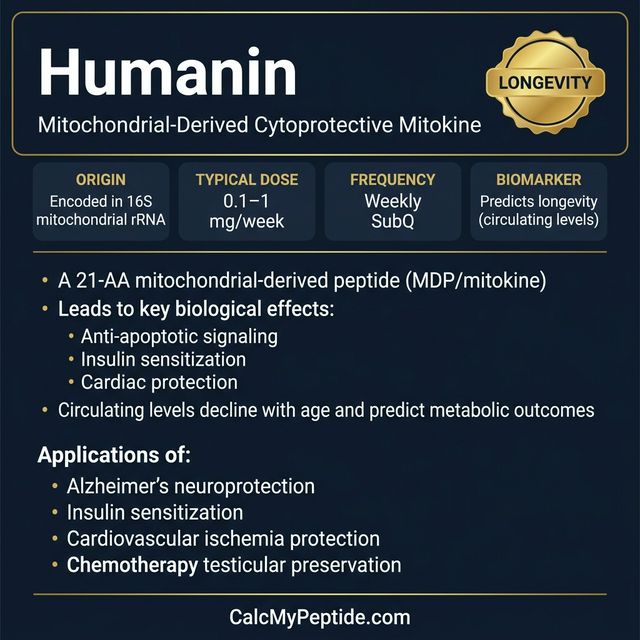
Humanin is a 21-amino-acid mitochondria-derived peptide (MDP) discovered in 2001 by Nishimoto et al. (BBRC) while screening a human brain cDNA library for factors protecting against Alzheimer's-related neuronal death. It is encoded in the 16S rRNA region of mitochondrial DNA — like MOTS-c — making both of these peptides part of the emerging class of "mitokines" (mitochondria-derived signaling peptides). Circulating humanin levels decline with age and predict metabolic and cognitive health outcomes.
🎯 Research Use Cases
- ✓Alzheimer's disease neuroprotection (the original discovery context)
- ✓Insulin sensitization and type 2 diabetes prevention
- ✓Cardiovascular protection during ischemia
- ✓Longevity: circulating humanin is a positive longevity biomarker
- ✓Testicular function preservation during chemotherapy
💉 Dosing Protocol
| Typical Dose | 1-5 mg/day (research) |
| Frequency | 1× daily |
| Half-Life | ~30 minutes |
| Common Vial Sizes | 5 mg |
🧪 Reconstitution Example
⚠️Safety & Considerations
Endogenous mitochondrial peptide. Limited human clinical data but strong preclinical safety. Research peptide status. May affect insulin sensitivity — monitor if diabetic.
⚡Interactions & Contraindications
Limited human safety data. IGF-1 receptor signaling involvement — potential theoretical interaction with IGF-1 LR3. No significant drug interactions documented in available research. Injectable form preferred (oral stability uncertain).
🔗Synergies & Common Stacks
Both are mitochondrial-derived peptides with complementary effects: MOTS-c optimizes metabolic function; Humanin provides cytoprotection and apoptosis inhibition. Core mitochondrial peptide stack.
SS-31 protects the inner mitochondrial membrane; Humanin signals systemically as a cytoprotective mitokine. Comprehensive mitochondrial health and protection.
❓ Frequently Asked Questions
How is Humanin related to MOTS-c?▼
Why do Humanin levels decline with age?▼
📖 References
- Hashimoto Y, et al. “Humanin is a neuroprotective mitochondrial-derived peptide.” Proc Natl Acad Sci USA (2001). PMID: 11481436
- Yen K, et al. “Humanin and age-related diseases.” Biochim Biophys Acta (2013). PMID: 23291260