What Is Peptide Reconstitution?
Reconstitution is the process of dissolving a lyophilized (freeze-dried) peptide powder into a sterile liquid — typically bacteriostatic water (BAC water) — to create an injectable solution. Peptide manufacturers ship products as dry powder because lyophilization dramatically extends shelf life, preserving molecular integrity during transit and storage.
This step is not optional and it is not trivial. The volume of water you add directly determines the concentration of your solution, which in turn dictates how many syringe units you draw for each dose. Get it wrong, and you risk under- or over-dosing by a factor of two or more.
If you're reconstituting for the first time, read every step below carefully. If you've done it before, use this as a reference to ensure your technique is airtight.
What You'll Need (Checklist)
• A lyophilized peptide vial — typically 5 mg or 10 mg (e.g., BPC-157, TB-500, semaglutide)
• Bacteriostatic water (BAC water) — sterile water with 0.9% benzyl alcohol as preservative
• Insulin syringes — 0.3 mL (30 units), 0.5 mL (50 units), or 1.0 mL (100 units)
• Alcohol swabs — individually wrapped, 70% isopropyl alcohol
• A clean, flat, well-lit workspace — wipe down with rubbing alcohol before starting
• A permanent marker and label — for dating the reconstituted vial
Step-by-Step Reconstitution Process
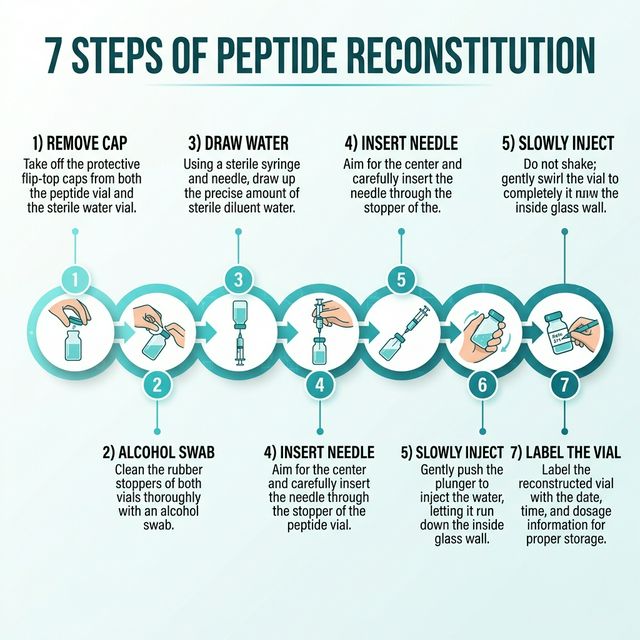
1. Prep your workspace. Lay out all supplies on a clean surface. Wash your hands thoroughly.
2. Remove the plastic flip-cap from the peptide vial, exposing the rubber stopper. Do not remove the stopper itself.
3. Swab the rubber stopper with an alcohol pad. Let it air-dry for 10 seconds — this prevents contaminants from entering the vial.
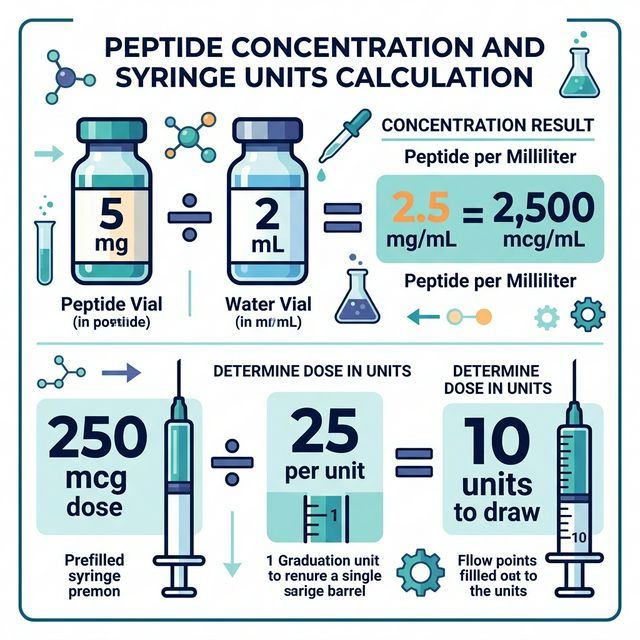
4. Draw your chosen volume of BAC water into a fresh syringe. For example, 2 mL for a 5 mg vial creates a 2.5 mg/mL concentration.
5. Insert the syringe needle through the rubber stopper at a slight angle. Slowly inject the BAC water along the inside wall of the vial — never spray directly onto the peptide cake.
6. Allow the water to trickle down the glass wall onto the powder. Gravity does the work. This preserves the peptide's molecular structure.
7. Once all water is added, gently swirl (never shake!) the vial until the powder is fully dissolved. The solution should be perfectly clear and colorless.
8. Label the vial with: peptide name, concentration (mg/mL), date reconstituted, and expected expiry (28 days).
The Reconstitution Formula
Example: 5 mg BPC-157 + 2 mL BAC water = 2.5 mg/mL = 2,500 mcg/mL
From the concentration, calculate your syringe draw:
For a 100-unit (1 mL) syringe with 2,500 mcg/mL: each unit delivers 25 mcg. For a 250 mcg dose, draw exactly 10 units.
Quick Reference: Common Reconstitution Examples
| Peptide | Vial | Water | Conc. | Dose | Draw |
|---|---|---|---|---|---|
| BPC-157 | 5 mg | 2 mL | 2,500 mcg/mL | 250 mcg | 10 units |
| TB-500 | 5 mg | 2 mL | 2,500 mcg/mL | 750 mcg | 30 units |
| Semaglutide | 5 mg | 2.5 mL | 2,000 mcg/mL | 250 mcg | 12.5 units |
| CJC-1295 | 5 mg | 2.5 mL | 2,000 mcg/mL | 300 mcg | 15 units |
| Ipamorelin | 5 mg | 2.5 mL | 2,000 mcg/mL | 200 mcg | 5 units |
| GHK-Cu | 10 mg | 2 mL | 5,000 mcg/mL | 500 mcg | 10 units |
Choosing the Right Syringe Size
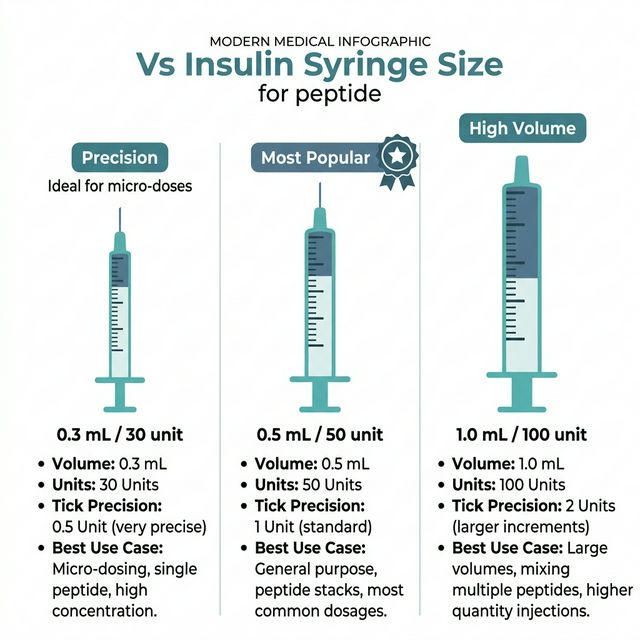
• 0.3 mL / 30 units — Best for extremely small doses (< 15 units). Each tick = 0.5 units, giving the finest precision available. Ideal for highly concentrated solutions.
• 0.5 mL / 50 units — The most popular choice for peptide use. Each tick = 1 unit. A good balance of precision and volume capacity.
• 1.0 mL / 100 units — Best when drawing larger volumes (> 30 units), common with GLP-1 peptides. Each tick = 1 unit = 0.01 mL. Watch out for 2-unit tick mark models.
💡 Pro Tip: Always match your syringe to the dose volume. If your calculated draw is under 15 units, choose a 30u syringe for maximum accuracy.
Storage After Reconstitution
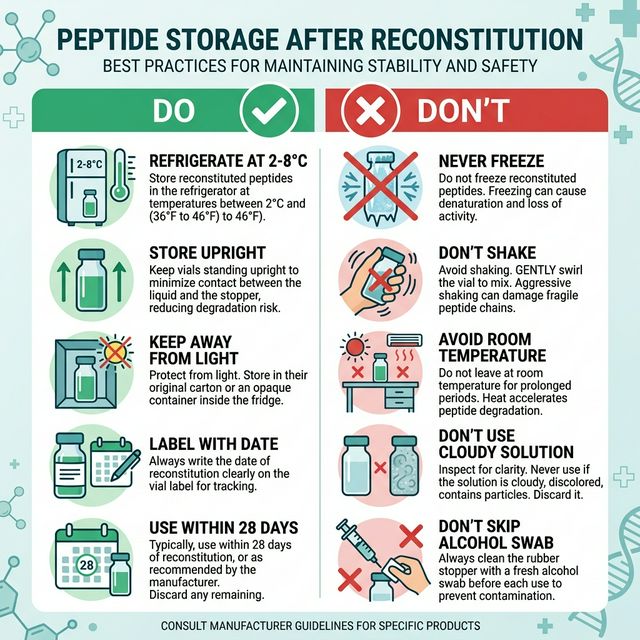
Once reconstituted, peptides are in solution and begin degrading. Proper storage is critical:
• Refrigerate immediately at 2-8°C (36-46°F) — the standard lab refrigerator range
• Most reconstituted peptides remain stable for 21-28 days
• Never freeze a reconstituted vial — ice crystals destroy the peptide's molecular structure
• Store vials upright to keep the solution away from the rubber stopper
• Protect from light — wrap in foil if your refrigerator has a glass door
Use the CalcMyPeptide Vial Duration Calculator to estimate how many days your vial will last based on your dosing schedule.
Common Mistakes to Avoid
• Shaking the vial — Agitation denatures peptide bonds. Always swirl gently in a circular motion.
• Using sterile water instead of BAC water — Sterile water has no preservative. Your vial becomes a bacterial growth medium within 24 hours.
• Spraying water directly onto the peptide cake — High-velocity impact can damage the molecular structure. Let water flow down the vial wall.
• Forgetting to label the vial — Without a reconstitution date, you have no way to track the 28-day expiration window.
• Storing at room temperature — Reconstituted peptides degrade significantly faster above 8°C.
• Reusing syringes — Each needle puncture into the BAC water or peptide vial should use a fresh, sterile syringe.
Frequently Asked Questions
FAQ_SECTION