
Why Compounded Semaglutide Exists
Compounded semaglutide exists because of a specific FDA provision: when an FDA-approved drug is in shortage, compounding pharmacies are permitted to compound copies of that drug to alleviate the shortage. From late 2022 through early 2024, semaglutide (Ozempic and Wegovy) was officially listed on the FDA Drug Shortage database due to overwhelming demand that Novo Nordisk could not meet with its existing manufacturing capacity.
This shortage listing activated Section 503B of the FD&C Act, allowing outsourcing facilities to compound semaglutide — the same active ingredient as Ozempic/Wegovy — at dramatically lower cost. Compounded semaglutide typically costs $100-400 per month versus $1,000-1,600 per month for brand Wegovy. The price difference created an enormous market: by 2025, an estimated 1-2 million Americans were using compounded semaglutide.
The critical regulatory question in 2026: the FDA resolved the semaglutide shortage in February 2024, then re-listed it, creating regulatory whiplash. Novo Nordisk has challenged compounding, arguing that the shortage is resolved and compounding should stop. Multiple federal courts have issued rulings on both sides. The legal situation remains in flux.
Is Compounded Semaglutide the Same Molecule?
Yes — when properly compounded. Semaglutide is a 31-amino-acid GLP-1 receptor agonist with a specific structure: the GLP-1(7-37) backbone with Aib at position 8, Arg at position 34, and a C18 fatty di-acid moiety linking via a spacer to Lys at position 26. This structure is what enables the 7-day half-life via albumin binding. A reputable compounding pharmacy synthesizes or sources the identical molecule.
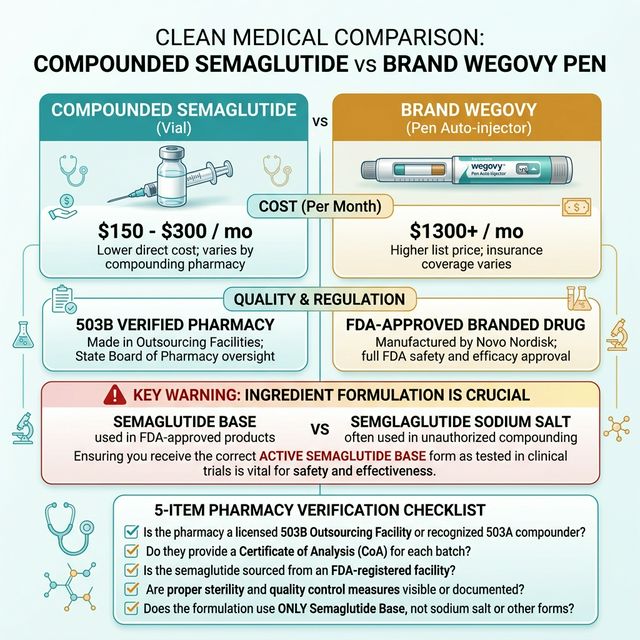
The differences are in formulation and quality controls, not in the active ingredient: Brand Wegovy comes in pre-filled injection pens at fixed concentrations (0.25 mg, 0.5 mg, 1.0 mg, 1.7 mg, 2.4 mg per dose). No reconstitution is needed. Each pen delivers the exact prescribed dose per click. The manufacturing occurs in Novo Nordisk's FDA-inspected facilities under cGMP conditions.
Compounded semaglutide typically comes as lyophilized powder in multi-dose vials requiring reconstitution with bacteriostatic water. You must calculate the concentration, draw the correct volume in a syringe, and self-inject. This is where the CalcMyPeptide reconstitution calculator and GLP-1 Scheduler become essential — getting the concentration math wrong means getting the dose wrong.
Quality and Safety Considerations
The safety of compounded semaglutide depends entirely on the compounding pharmacy. From 503B outsourcing facilities with FDA oversight and cGMP manufacturing: the quality is comparable to brand. Testing includes HPLC purity verification, endotoxin testing, sterility testing, and potency confirmation. These facilities undergo FDA inspections.
From less rigorous sources: quality can vary. In 2023, the FDA issued warnings after patients experienced adverse events from improperly compounded semaglutide, including sterility failures. The FDA specifically warned about semaglutide sodium salt (a different salt form with different pharmacokinetics) being substituted for semaglutide base in some compounded preparations.
What to verify: (1) Is the pharmacy a registered 503B outsourcing facility? (2) Does the CoA specify semaglutide base (not semaglutide sodium)? (3) Does testing include HPLC purity, endotoxin, and sterility? (4) Does the vial label include concentration, lot number, beyond-use date, and storage instructions? (5) Is a licensed prescriber involved in your care, monitoring your GI symptoms, weight, and metabolic markers during escalation?
The Bottom Line: Access vs Quality Trade-offs
Compounded semaglutide from a reputable 503B facility provides 80% of the quality at 20% of the cost — for most patients, this is a rational trade-off. Brand Wegovy provides the highest quality assurance, the convenience of pre-filled pens, and the backing of Phase III clinical trial data on that specific formulation.
The practical recommendation: if you can access brand Wegovy through insurance or can afford the out-of-pocket cost, it is the cleanest option. If cost is prohibitive, compounded semaglutide from a 503B outsourcing facility is a medically reasonable alternative when supervised by a prescriber. Avoid unregistered compounding sources, peptide vendors selling semaglutide as "research chemicals," or any source that cannot provide lot-specific testing data.
Regardless of source, the dosing math is the same. Use the CalcMyPeptide GLP-1 Dose Scheduler for your week-by-week escalation plan, and the reconstitution calculator to convert your vial concentration into exact syringe units. Dose accuracy is equally important whether you are using brand or compounded product.