CagriSema
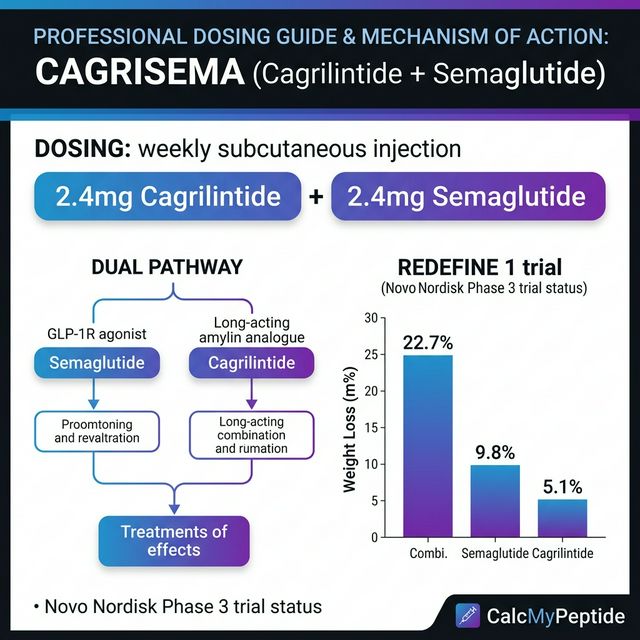
Fixed-ratio co-formulation of cagrilintide (amylin analog) and semaglutide (GLP-1 agonist) in Phase III REDEFINE trials — showing ~22-25% body weight reduction, outperforming either agent alone.
🔬 Mechanism of Action
CagriSema is a fixed-ratio co-formulation combining cagrilintide 2.4 mg (amylin analog) and semaglutide 2.4 mg (GLP-1 agonist) in a single weekly subcutaneous injection. The mechanistic rationale is that amylin and GLP-1 receptors are anatomically distinct and activate complementary neural circuits for appetite and satiety.
Semaglutide activates GLP-1 receptors (GLPR1) primarily in the hypothalamus (arcuate nucleus, paraventricular nucleus) and brainstem NTS, producing appetite suppression, insulin secretion, glucagon suppression, and gastric slowing. Cagrilintide activates calcitonin receptor complexes (CALCR + RAMPs) in the area postrema and NTS — different anatomical sites with different downstream signaling. Both converge on reducing caloric intake and increasing satiety, but through non-competing pathways.
The Phase 2 CAGRISEMA data (NEJM, 2021) demonstrated this pharmacological synergy: ~15.6% body weight loss at 26 weeks — nearly 2× what semaglutide alone achieved. Phase 3 REDEFINE-1 results (2025) demonstrated 22.7% weight loss at 68 weeks in adults with obesity — approaching the efficacy ceiling previously believed only achievable through bariatric surgery.
Source: PMID: 35948058 (CAGRISEMA Phase 2), NCT05634603 (REDEFINE Phase 3)
📜Background & History
CagriSema is a fixed-ratio co-formulation of cagrilintide 2.4 mg and semaglutide 2.4 mg in a single weekly injection, developed by Novo Nordisk. After Phase 2 results (NEJM, 2022) showed ~15.6% body weight reduction — significantly exceeding either monotherapy — Novo Nordisk advanced CagriSema into the Phase 3 REDEFINE program (NCT05634603). The REDEFINE-1 results reported in early 2025 showed 22.7% body weight loss at 68 weeks. The rationale is mechanistically elegant: semaglutide targets hypothalamic GLP-1 receptors while cagrilintide targets area postrema/NTS amylin receptors — anatomically distinct pathways that converge on appetite and energy expenditure without receptor competition or desensitization.
🎯 Research Use Cases
- ✓Severe obesity management with >20% weight loss goal
- ✓Weight loss superior to semaglutide alone in T2D patients
- ✓Metabolic syndrome with multiple cardiovascular risk factors
- ✓Research protocols seeking state-of-the-art incretin combination therapy
💉 Dosing Protocol
| Typical Dose | Cagrilintide 2.4 mg + Semaglutide 2.4 mg/week |
| Frequency | 1× weekly (combined injection) |
| Half-Life | Mixed (~7-8 days each component) |
| Common Vial Sizes | 5 mg |
🧪 Reconstitution Example
⚠️Safety & Considerations
Investigational combination. GI side effects (nausea, vomiting, diarrhea) are the primary adverse event — and more pronounced than semaglutide monotherapy due to additive gastric slowing from amylin + GLP-1. Same thyroid/MTC/MEN2 contraindications as GLP-1 agonists. Monitor glucose in T2D patients. Not yet FDA-approved — available via clinical trials or compounding pharmacies.
⚡Interactions & Contraindications
Dual GI mechanism (GLP-1 + amylin) means higher GI side effect burden than semaglutide alone — careful dose escalation is critical. Same MTC/MEN2 contraindications as GLP-1 agents. Amylin addition may affect insulin dosing in T2D patients — requires glucose monitoring. Investigational; available only through clinical trials as of 2025. Compounded cagrilintide + semaglutide is emerging from specialty pharmacies.
🔗Synergies & Common Stacks
CagriSema's aggressive GI effects during dose escalation may be mitigated by BPC-157's gastroprotective and mucosal repair properties — supporting tolerability.
While CagriSema drives massive caloric deficit and weight loss, MOTS-c supports metabolic flexibility and AMPK activity to preserve mitochondrial function during aggressive caloric restriction.