⚕️ Medical Disclaimer
**⚕️ Medical Disclaimer:** This article is for educational and informational purposes only. It does not constitute medical advice. Consult a qualified healthcare provider before using any peptide.
What Are Khavinson Bioregulators?
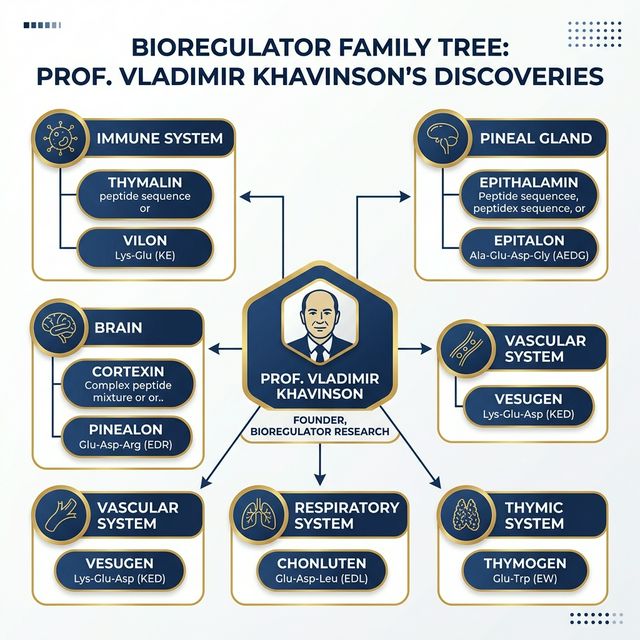
Khavinson bioregulators are a class of short peptides (2-4 amino acids) developed by Professor Vladimir Khavinson at the Saint Petersburg Institute of Bioregulation and Gerontology in Russia over four decades of research. These peptides are theorized to regulate gene expression at the epigenetic level — interacting directly with DNA to modulate specific organ-system functions.
*Last updated: March 2026*
The concept is radically different from most peptide therapy: rather than binding cell-surface receptors (like semaglutide binds GLP-1R or ipamorelin binds GHSR), Khavinson peptides are proposed to enter the cell nucleus and interact with complementary DNA sequences to upregulate or downregulate gene expression. Think of them as biological "software updates" for specific organs.
This field exists in a fascinating intersection of legitimate research (200+ published studies, some in peer-reviewed journals) and extraordinary claims (life extension, disease prevention, organ rejuvenation) that require healthy scientific skepticism. Let us walk through the evidence honestly.
The Science: Epigenetic Gene Regulation by Short Peptides
**Khavinson's central hypothesis: di-, tri-, and tetrapeptides can penetrate cell membranes and nuclear membranes to bind specific DNA sequences, modulating gene expression in a tissue-specific manner** (Khavinson et al., 2014, PMID: 25437836).
The proposed mechanism:
• Short peptides (2-4 amino acids) have molecular weights small enough to cross cell membranes without receptor-mediated endocytosis
• Once inside the nucleus, they bind to complementary DNA sequences in promoter regions
• This binding upregulates transcription of proteins specific to the target organ system
• The effect is proposed to be organ-specific because different short peptides have affinity for different DNA sequences
Published evidence supporting this mechanism includes in vitro studies showing short peptides binding to specific DNA sequences, modulating gene expression for proteins like Ki-67 (proliferation marker), VEGF (angiogenesis), and various tissue-specific proteins. However, most evidence is from Russian-language journals, and independent replication in Western labs is limited.
The quality of evidence varies significantly across the bioregulator family. Epithalon has the most data. Others have substantially less. Approach each compound individually rather than treating the entire class as equally validated.
Key Khavinson Bioregulator Peptides
| Peptide | Sequence | Target System | Proposed Function | Evidence Level |
|---|---|---|---|---|
| Epithalon (Epitalon) | Ala-Glu-Asp-Gly | Pineal gland | Telomerase activation, melatonin regulation | Best evidence; animal + limited human |
| Thymalin | Glu-Trp | Immune (thymus) | T-cell maturation, immune reconstitution | Approved in Russia; clinical data |
| Vilon | Lys-Glu | Immune system | Immune modulation | Russian clinical trials |
| Cortexin | Complex mix | CNS (brain) | Neuroprotection, cognitive function | Approved in Russia; pediatric + adult use |
| Pinealon | Glu-Asp-Arg | Pineal/CNS | Neuroprotection, circadian regulation | Limited preclinical |
| Vesugen | Lys-Glu-Asp | Vascular system | Endothelial function, vascular health | Limited preclinical |
| Chonluten | Glu-Asp-Gly | Respiratory | Bronchial mucosa health | Limited preclinical |
| Cartalax | Ala-Glu-Asp | Cartilage/Bone | Osteogenic differentiation, cartilage preservation | Limited preclinical |
Epithalon: The Flagship Bioregulator
**Epithalon (also spelled Epitalon) is a synthetic tetrapeptide (Ala-Glu-Asp-Gly) analog of epithalamin, a natural extract from the pineal gland.** It is the most studied Khavinson bioregulator and the primary compound driving longevity-focused interest in this class.
**Key claims and evidence:**
• **Telomerase activation:** Epithalon activated telomerase in human somatic cells in vitro, potentially extending replicative capacity (Khavinson et al., 2003, PMID: 14523363). This is the most frequently cited finding.
• **Life extension in animal models:** In rodent studies, epithalamin (the natural compound) extended mean lifespan by 25% in rats and reduced spontaneous tumor incidence (Anisimov et al., 2003, PMID: 12946225).
• **Melatonin regulation:** Epithalon restored nocturnal melatonin production in elderly patients with diminished pineal function, normalizing circadian rhythms.
• **No formal human longevity trial:** While the animal data is intriguing, no randomized controlled trial has demonstrated lifespan extension in humans. The leap from rodent lifespan data to clinical claims requires caution.
**Dosing protocol (community standard, not clinically validated):**
• 5-10 mg SubQ daily for 10-20 days (one "course")
• Repeat courses every 4-6 months
• Some users run 1-2 mg/day for 30 days as a gentler approach
Use our Reconstitution Calculator for exact syringe draws.
Thymalin: Immune System Bioregulation
**Thymalin is a dipeptide (Glu-Trp) bioregulator targeting the thymus, approved in Russia for immune restoration.** The thymus gland involutes (shrinks) with age, contributing to immunosenescence — the progressive decline in immune function responsible for increased infection susceptibility and cancer risk in the elderly.
**Evidence:**
• Thymalin treatment in elderly patients (60-80 years) was associated with reduced mortality over a 6-year follow-up period compared to controls, in a non-randomized study from Khavinson's institute.
• Clinical use in Russia includes post-operative immune recovery, chronic infection management, and geriatric immune support.
• Western independent replication is minimal. The clinical studies are primarily from Russian institutions with methodological limitations (small sample sizes, lack of blinding).
**Dosing (Russian clinical protocol):**
• 10 mg IM daily for 5-10 days, repeated every 3-6 months
• SubQ administration is preferred in the biohacking community
If you are interested in immune-modulating peptides more broadly, thymosin alpha-1 (approved in 30+ countries) has a substantially larger international evidence base. TB-500 (thymosin beta-4 analog) addresses a different aspect of immune/repair function — see our TB-500 guide.
Critical Assessment: Strengths and Limitations of the Evidence
**Strengths:**
• Four decades of continuous research with 200+ publications
• Russian regulatory approval for thymalin and cortexin provides a clinical safety framework
• The concept of short peptides interacting with DNA is biologically plausible — peptide-DNA interactions are well-established in molecular biology
• Animal lifespan extension data for epithalon is consistent across multiple studies
**Limitations:**
• Most published studies originate from Khavinson's own institute — independent replication by Western labs is sparse
• Many studies are published in Russian-language journals not indexed in PubMed
• Clinical trial methodology often falls below modern Western standards (small n, lack of blinding, no placebo control)
• The leap from "short peptide binds DNA in vitro" to "organ-specific rejuvenation in humans" involves multiple unvalidated assumptions
• Commercial bioregulator products have significant quality and sourcing concerns — there is no USP-grade verification for most compounds
**The bottom line:** Khavinson bioregulators represent a scientifically fascinating research direction with preliminary supporting evidence. They are not evidence-based medicine by Western regulatory standards. Users should approach them with intellectual curiosity tempered by appropriate skepticism.
For comparison with better-validated peptide categories, see our peptide safety guide and beginner guide.
Frequently Asked Questions
**Is epithalon proven to extend human lifespan?** No — no controlled human trial has demonstrated lifespan extension with epithalon. The evidence base consists of in vitro telomerase activation, rodent lifespan studies, and observational human data on melatonin normalization. These are encouraging but insufficient to support clinical longevity claims.
**Are Khavinson bioregulators safe?** The safety profile appears favorable based on decades of Russian clinical use with thymalin and cortexin. However, the lack of Western regulatory oversight and independent safety monitoring means the evidence is incomplete. Short peptides (2-4 amino acids) are generally considered low-risk due to rapid clearance and lack of receptor-mediated toxicity.
**Can I buy bioregulators legally?** Khavinson bioregulators are sold as research compounds in most Western countries. They are not FDA-approved. Quality varies dramatically between suppliers — seek vendors with third-party CoA (certificate of analysis) testing.
**How do bioregulators compare to BPC-157 or ipamorelin?** Different mechanisms entirely. BPC-157 and ipamorelin work through cell-surface receptor activation (immediate, measurable effects within days). Bioregulators theoretically modulate gene expression (subtle, long-term effects over weeks to months). They can be used concurrently without interaction concerns.
**What blood work should I get before starting bioregulators?** Comprehensive baseline panels including CBC, CMP, hormone panel (thyroid, testosterone, estrogen), melatonin (for epithalon), and IGF-1. Use our blood work guide for the full checklist.
Final Word
**⚕️ Medical Disclaimer:** This article is for educational and informational purposes only. It does not constitute medical advice. Consult a qualified healthcare provider before using any peptide.