DSIP
Neuropeptide that promotes delta wave (deep) sleep and may modulate cortisol/LH rhythms.
🔬 Mechanism of Action
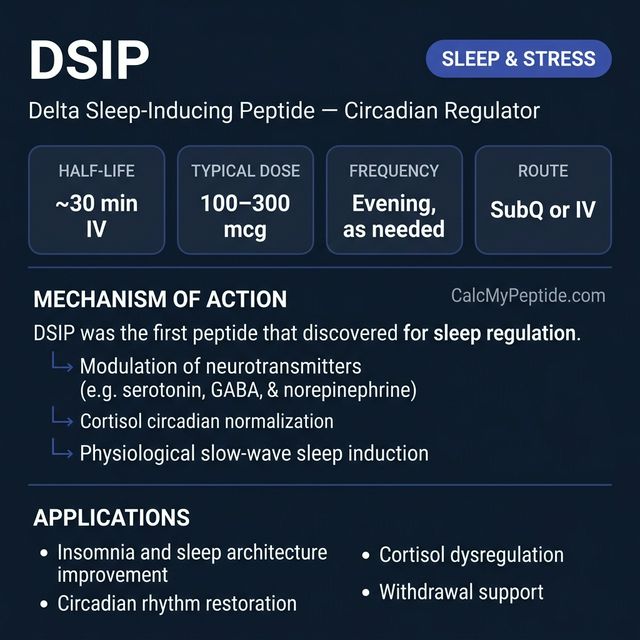
DSIP (Delta Sleep-Inducing Peptide) is a naturally occurring nonapeptide that promotes delta-wave (Stage 3/4 deep) sleep — the most restorative phase of the sleep cycle. It crosses the blood-brain barrier and modulates the hypothalamic-pituitary-adrenal (HPA) axis, potentially normalizing cortisol rhythms and improving sleep architecture.
DSIP also modulates LH (Luteinizing Hormone) pulsatility, which may benefit hormonal balance. Despite its very short half-life (~7-8 minutes), DSIP appears to have lasting effects on sleep architecture, suggesting it acts as a signaling trigger rather than requiring sustained plasma levels.
Source: PMID: 6325741
📜Background & History
DSIP (Delta Sleep-Inducing Peptide) is a nonapeptide first isolated from rabbit cerebral venous blood by Marcel Monnier at the University of Basel in 1977. It was the first peptide identified specifically for sleep regulation and produced normal physiological slow-wave sleep in animal and human experiments without the hangover effects of pharmacological sleep aids. Its mechanisms include modulation of serotonin, norepinephrine, and GABA systems, as well as normalization of cortisol circadian rhythms — making it useful beyond sleep into stress resilience.
🎯 Research Use Cases
- ✓Insomnia treatment: reducing sleep onset and improving slow-wave sleep
- ✓Circadian rhythm normalization in shift workers or jet lag
- ✓Reducing stress-induced cortisol dysregulation
- ✓Opioid and alcohol withdrawal support (preclinical data)
- ✓General performance recovery via improved sleep architecture
💉 Dosing Protocol
| Typical Dose | 100-300 mcg before bed |
| Frequency | 1× daily before bed |
| Half-Life | ~7-8 minutes |
| Common Vial Sizes | 5 mg |
🧪 Reconstitution Example
⚠️Safety & Considerations
Research peptide. Generally well-tolerated. May cause drowsiness (expected effect). Not known to be habit-forming. Limited clinical trial data. Inject 30-60 minutes before bed.
⚡Interactions & Contraindications
Additive sedative effects with benzodiazepines, z-drugs, or antihistamines — reduce doses of sleeping medications when using DSIP. Alcohol amplifies CNS depressant effects. May normalize cortisol rhythm — if using steroids/HRT, timing may be affected.
🔗Synergies & Common Stacks
Daytime anxiety reduction (Selank) + nighttime sleep restoration (DSIP) creates a comprehensive stress-sleep protocol.
Epitalon restores melatonin production; DSIP induces slow-wave sleep. Together they address both melatonin quantity and sleep quality architecture.
❓ Frequently Asked Questions
How does DSIP work with such a short half-life?▼
What is the DSIP dosing protocol?▼
📖 References
- Schneider-Helmert D, Schoenenberger GA. “Delta sleep-inducing peptide (DSIP): an update.” Peptides (1983). PMID: 6318203
- Schneider-Helmert D. “Effect of DSIP on sleep disorders in depressive patients.” Eur Neurol (1984). PMID: 6430276