GHK-Cu
Copper tripeptide naturally occurring in plasma; studied for skin repair, wound healing, and hair growth.
🔬 Mechanism of Action
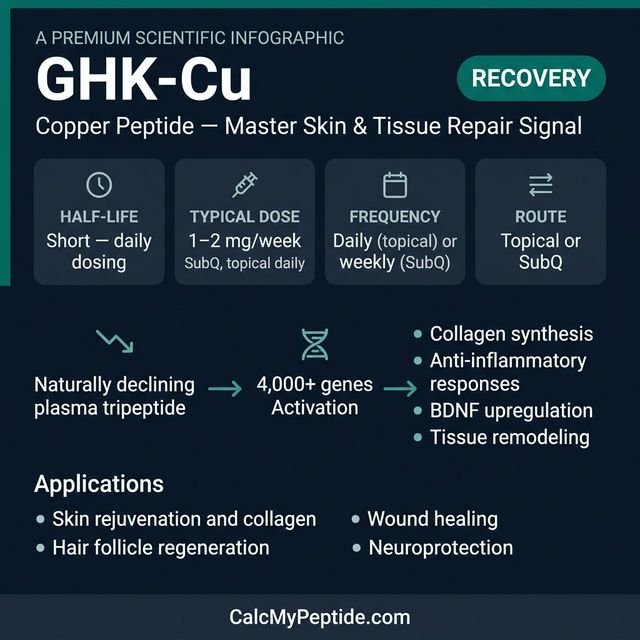
GHK-Cu (Glycyl-L-histidyl-L-lysine:copper(II)) is a naturally occurring copper tripeptide found in human plasma, saliva, and urine. Plasma levels decline significantly with age — from ~200 ng/mL at age 20 to ~80 ng/mL by age 60. GHK-Cu has broad biological activities: it stimulates collagen synthesis (Types I and III), glycosaminoglycan production (chondroitin sulfate, dermatan sulfate), and decorin synthesis.
GHK-Cu is unique in being effective both topically and systemically. It promotes wound healing, skin remodeling, hair growth (by enlarging hair follicles and extending the anagen growth phase), and has anti-inflammatory and antioxidant properties. It is one of the few peptides with robust cosmetic and medical applications.
Source: PMID: 18492131
📜Background & History
GHK-Cu (Glycyl-L-Histidyl-L-Lysine:copper) was discovered by Loren Pickart in 1973 while investigating why liver cells of aged humans behaved differently from young plasma. He isolated GHK as the causative factor in youthful plasma that reprogrammed aged cells. The copper complex GHK-Cu is found naturally in human plasma, saliva, and urine, declining with age. It is one of the most pleiotropic peptides known — activating over 4,000 genes — and has been called a "master skin repair signal." Topical cosmetic use is widespread; injectable research use is growing.
🎯 Research Use Cases
- ✓Skin rejuvenation: collagen synthesis, wrinkle reduction, wound healing
- ✓Hair growth stimulation and follicle regeneration
- ✓Anti-inflammatory via TNF-α, IL-6 suppression
- ✓Tissue repair: lung, bone, liver remodeling in animal models
- ✓Neuroprotection via BDNF upregulation
💉 Dosing Protocol
| Typical Dose | 1-3 mg/day (SC) or topical |
| Frequency | 1× daily |
| Half-Life | ~1-2 hours (estimated) |
| Common Vial Sizes | 5 mg, 50 mg |
🧪 Reconstitution Example
⚠️Safety & Considerations
Naturally occurring human peptide with an excellent safety profile. Available as both injectable and topical formulations. Topical use is well-established in cosmetics. Injectable use is off-label. Copper peptides should not be mixed with vitamin C (ascorbic acid) or AHAs in topical applications.
⚡Interactions & Contraindications
Topical formulations: minimal systemic absorption — extremely safe. Injectable: copper accumulation possible with excessive doses (keep to research protocols). Do not use concurrently with copper chelators (e.g., penicillamine). Very favorable safety profile at therapeutic doses.
🔗Synergies & Common Stacks
BPC-157 drives angiogenesis and growth factor expression; GHK-Cu amplifies collagen synthesis and dermal matrix remodeling. Complementary wound healing and skin repair synergy.
TB-500 (actin regulation) + GHK-Cu (collagen/matrix synthesis) together support comprehensive connective tissue restoration.
❓ Frequently Asked Questions
Can GHK-Cu be used topically or only by injection?▼
Does GHK-Cu help with hair growth?▼
📖 References
- Pickart L, Margolina A. “GHK peptide as a natural modulator of multiple cellular pathways in skin biology.” Biomed Res Int (2015). PMID: 26236730
- Pickart L. “The human tripeptide GHK-Cu in prevention and treatment of skin aging.” Int J Cosmet Sci (2012). PMID: 22486774