Why Proper Peptide Storage Matters
Peptide storage is not optional — it directly determines whether your peptide retains its biological activity or degrades into an expensive vial of amino acid fragments. Improper storage can reduce potency by 50-100% in days.
This guide covers the science of peptide degradation, optimal storage conditions for both lyophilized (powder) and reconstituted peptides, and practical solutions for travel.
Lyophilized (Powder) Peptide Storage
Lyophilized peptides are freeze-dried and extremely stable when stored correctly.
• Temperature: Store at -20°C to 4°C (freezer or refrigerator). Freezer is ideal for long-term storage.
• Duration: Most lyophilized peptides remain stable for 12-24 months at -20°C and 6-12 months at 2-8°C.
• Light: Keep in original packaging or wrap in aluminum foil. UV light causes photo-degradation.
• Moisture: The lyophilization process removes all water. Any moisture contamination will begin degradation. Keep vials sealed.
Key point: Unreconstituted peptides in sealed vials can survive brief temperature excursions (e.g., shipping), but extended exposure above 25°C accelerates degradation.
Reconstituted Peptide Storage
Once you add bacteriostatic water to a peptide vial, the clock starts ticking.
• Temperature: Refrigerate immediately at 2-8°C (36-46°F). Never leave reconstituted peptides at room temperature.
• Duration: Most reconstituted peptides remain stable for 21-28 days when properly refrigerated.
• Never freeze reconstituted peptides — ice crystal formation destroys the peptide's 3D molecular structure.
• Store vials upright to minimize rubber stopper contact with the solution.
• Protect from light — wrap in aluminum foil if your refrigerator has a glass door or bright interior light.
• Label every vial with: peptide name, concentration, reconstitution date, and 28-day expiry date.
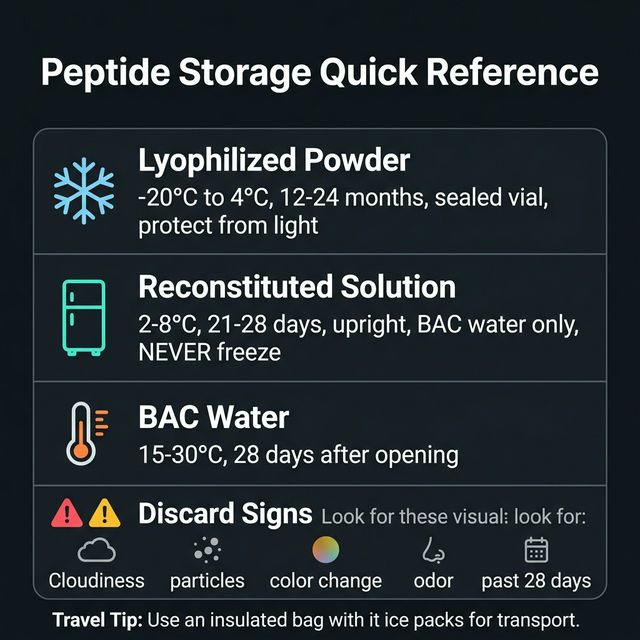
Storage Matrix: Quick Reference
| Form | Temperature | Duration | Light | Container |
|---|---|---|---|---|
| Lyophilized (sealed) | -20°C to 4°C | 12-24 months | Protected | Original sealed vial |
| Lyophilized (opened) | 2-8°C | 3-6 months | Protected | Re-sealed vial |
| Reconstituted (BAC water) | 2-8°C | 21-28 days | Protected | Same vial |
| Reconstituted (sterile water) | 2-8°C | 24 hours max | Protected | Same vial |
| BAC water (unopened) | 15-30°C | Years | N/A | Original container |
| BAC water (opened) | 15-30°C | 28 days | N/A | Same container |
Degradation Signs: When to Discard
Inspect your reconstituted peptide before every injection. Discard immediately if you observe:
• Cloudiness or turbidity — the solution should always be crystal clear
• Visible particles or floaters — indicates protein aggregation or contamination
• Color change — should remain water-clear with no yellow or brown tint
• Unusual odor — reconstituted peptides should be odorless
• Past the 28-day mark — even if the solution looks clear
When in doubt, discard. A new vial is always cheaper than the consequences of using degraded product.
Travel Storage Solutions
Traveling with peptides requires maintaining the cold chain:
• Short trips (1-3 days): Use an insulated lunch bag with ice packs. Standard gel packs maintain 2-8°C for 8-12 hours.
• Air travel: Pack peptides in carry-on luggage. Checked bags experience extreme temperature variations. Keep a copy of any prescription or medical letter.
• Extended travel: Consider a portable medication cooler (Frio wallet or similar) — these use evaporative cooling and maintain safe temperatures for 24-48 hours.
• Hotel: Request a mini-fridge or use the minibar refrigerator. Temperature should be 2-8°C.
💡 Pro Tip: If traveling for longer than your vial will last, bring an unreconstituted vial and BAC water separately. Reconstitute at your destination.