⚕️ Medical Disclaimer
⚕️ Medical Disclaimer: This article is for educational and informational purposes only. It does not constitute medical advice. Consult a qualified healthcare provider before using any peptide.
What Is GHK-Cu and How Does It Promote Hair Growth?
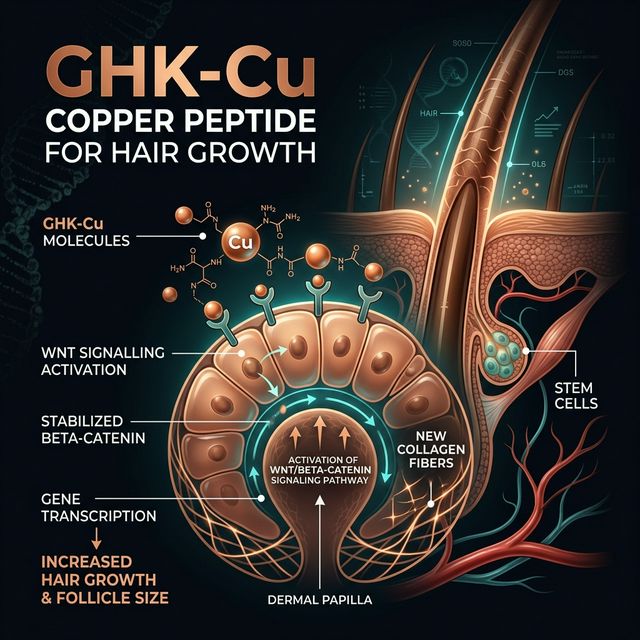
GHK-Cu (glycyl-L-histidyl-L-lysine copper complex) is a naturally occurring tripeptide-copper complex found in human plasma, saliva, and urine. It was first identified by Dr. Loren Pickart in 1973 as a peptide in aged human serum that could regenerate liver cells to behave like younger tissue. GHK-Cu promotes hair growth through multiple mechanisms: upregulation of Wnt/β-catenin signaling (the master pathway for hair follicle neogenesis), increased VEGF production (enhancing blood supply to follicles), and stimulation of dermal papilla cell proliferation (Pickart et al., 2012, PMID: 23019194).
Last updated: March 2026
GHK-Cu Dosing Protocol for Hair and Skin
SubQ injection: 1-2 mg daily, subcutaneously (scalp or abdomen). Topical (serums/creams): Apply 1-2× daily to scalp or skin. Topical bioavailability is lower than SubQ. Reconstitution for 50 mg vial: Add 2 mL BAC water → 25 mg/mL. For 1 mg: 4 units. For 2 mg: 8 units on a U-100 insulin syringe. Cycle: 8-12 weeks, then 4-week break.
Use the Reconstitution Calculator for exact dosing math at any vial size. Use the Vial Duration Calculator to see how long your vial will last.
How GHK-Cu Works: Collagen, Wnt Signaling, and Follicle Regeneration
Collagen synthesis: GHK-Cu upregulates collagen I, collagen III, elastin, and decorin production in fibroblasts — the structural proteins that define skin firmness and scalp health. Wnt/β-catenin activation: This signaling pathway controls hair follicle cycling. GHK-Cu activates Wnt ligands, pushing resting (telogen) follicles into active growth (anagen) phase. VEGF production: Increased vascular endothelial growth factor improves blood supply to the dermal papilla — the structure that feeds the hair follicle (Pyo et al., 2007, PMID: 17387413).
Antioxidant defense: GHK-Cu activates antioxidant genes (SOD1, SOD2, glutathione peroxidase) that protect follicle stem cells from oxidative damage — a significant factor in age-related hair thinning.
GHK-Cu vs Minoxidil vs Finasteride for Hair Loss
| Feature | GHK-Cu | Minoxidil | Finasteride |
|---|---|---|---|
| Mechanism | Wnt activation + collagen + VEGF | Potassium channel opener (blood flow) | 5α-reductase inhibitor (blocks DHT) |
| Route | SubQ or topical | Topical | Oral |
| Hair Regrowth | Moderate (emerging data) | Moderate | Moderate-Strong |
| Skin Benefits | ✅ Collagen, elastin, wound healing | ❌ | ❌ |
| Side Effects | Minimal (injection site) | Scalp irritation, initial shedding | Sexual side effects (2-5%) |
| Works for Women | ✅ Yes | ✅ Yes (2% topical) | ❌ No (teratogenic) |
GHK-Cu is unique because it addresses both hair AND skin aging through the same mechanism. For women, see best peptides for women over 40.
Timeline: When Will I See Results?
Weeks 1-4: Reduced hair shedding, improved scalp skin quality. Weeks 4-8: Visible new vellus (fine) hair growth in thinning areas, noticeable skin texture improvement. Weeks 8-12: Thickening of existing hair, continued new growth. Months 3-6: Full assessment of terminal hair conversion and density improvement.
Results vary significantly by individual, underlying cause of hair loss, and application method (SubQ generally outperforms topical). Combine with a dermatological assessment for AGA (androgenetic alopecia) pattern identification.
Frequently Asked Questions
Is GHK-Cu better applied topically or injected? SubQ injection provides higher bioavailability but requires reconstitution. Topical serums are more convenient but less bioavailable. Many users combine both — SubQ for systemic effects + topical for targeted scalp delivery.
Can GHK-Cu be combined with minoxidil? Yes — they work through different mechanisms (Wnt signaling vs vasodilation). No known interaction.
Does GHK-Cu help with wrinkles? Yes — the same collagen/elastin upregulation that benefits hair also improves skin firmness, reduces fine lines, and enhances wound healing.
How should I store GHK-Cu? Lyophilized powder: -20°C long-term, 2-8°C for months. Reconstituted: 2-8°C, use within 28 days. The copper complex gives it a blue-green tint (normal).
Is GHK-Cu safe for women? Yes — unlike finasteride (contraindicated in women of childbearing age), GHK-Cu has no hormonal mechanism and is safe for both sexes.