SS-31
Mitochondria-targeting tetrapeptide that stabilizes cardiolipin and restores bioenergetics.
🔬 Mechanism of Action
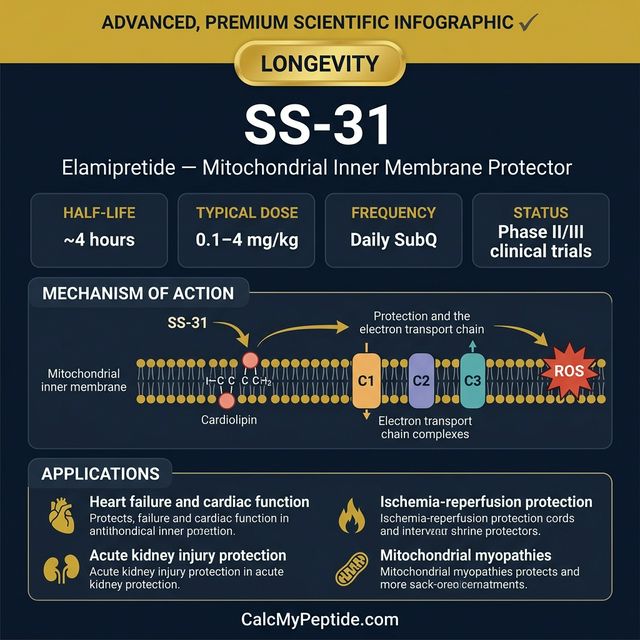
SS-31 (Elamipretide, Bendavia) is a mitochondria-targeting tetrapeptide (D-Arg-Dmt-Lys-Phe-NH2) that selectively binds to cardiolipin on the inner mitochondrial membrane. Cardiolipin is essential for electron transport chain function — when it becomes oxidized with age, mitochondrial efficiency declines. SS-31 prevents cardiolipin peroxidation, restoring mitochondrial bioenergetics.
SS-31 is unique among peptides in that it concentrates 1000-5000× in mitochondria versus the extracellular space. It is in clinical trials for Barth syndrome, age-related macular degeneration, and primary mitochondrial myopathy.
Source: PMID: 26857943
📜Background & History
SS-31 (Elamipretide, MTP-131) is a tetrapeptide targeting cardiolipin — a phospholipid exclusively located in the inner mitochondrial membrane critical for electron transport chain function. Developed by Hazel Szeto at Weill Cornell Medical College in the 2000s, SS-31 penetrates the inner mitochondrial membrane (unique for a water-soluble peptide) and protects cardiolipin from oxidative damage. Clinical trials have evaluated it in heart failure (BENEFIT-HF), kidney disease, and Barth syndrome. It is the most clinically advanced mitochondria-targeted therapeutic peptide.
🎯 Research Use Cases
- ✓Heart failure and cardiac function improvement
- ✓Acute kidney injury protection and recovery
- ✓Reducing mitochondrial oxidative stress in aging tissues
- ✓Skeletal muscle energetics in mitochondrial myopathies
- ✓Ischemia-reperfusion injury protection (surgery, stroke, heart attack)
💉 Dosing Protocol
| Typical Dose | 20-40 mg/day (clinical trials) |
| Frequency | 1× daily |
| Half-Life | ~4 hours |
| Common Vial Sizes | 5 mg |
🧪 Reconstitution Example
⚠️Safety & Considerations
Investigational drug in active clinical trials. Not FDA-approved. Generally well-tolerated in clinical studies. Injection site reactions are the most common adverse event.
⚡Interactions & Contraindications
No significant drug interactions identified in clinical trials to date. SubQ injection required — oral bioavailability negligible. Investigational — not approved for clinical use outside of trials.
🔗Synergies & Common Stacks
Complementary mitochondrial protection: SS-31 protects the inner membrane and electron transport chain; MOTS-c activates AMPK metabolic signaling. Together address both structural and functional mitochondrial health.
NAD+ supports NADH/NAD+ cycling; SS-31 protects the complexes that use NADH. Additive protection of the electron transport chain.
❓ Frequently Asked Questions
What is SS-31 used for?▼
How does SS-31 differ from other mitochondrial peptides?▼
📖 References
- Szeto HH. “SS-31 peptide enables mitochondrial targeting drug delivery.” AAPS J (2006). PMID: 17233531
- Siegel MP, et al. “Mitochondria-targeted peptide SS-31 reverses mitochondrial dysfunction and reduces oxidative stress.” Aging Cell (2013). PMID: 23834033