MGF
Natural IGF-1 splice variant (IGF-1Ec) produced locally in damaged muscle tissue to initiate satellite cell activation.
🔬 Mechanism of Action
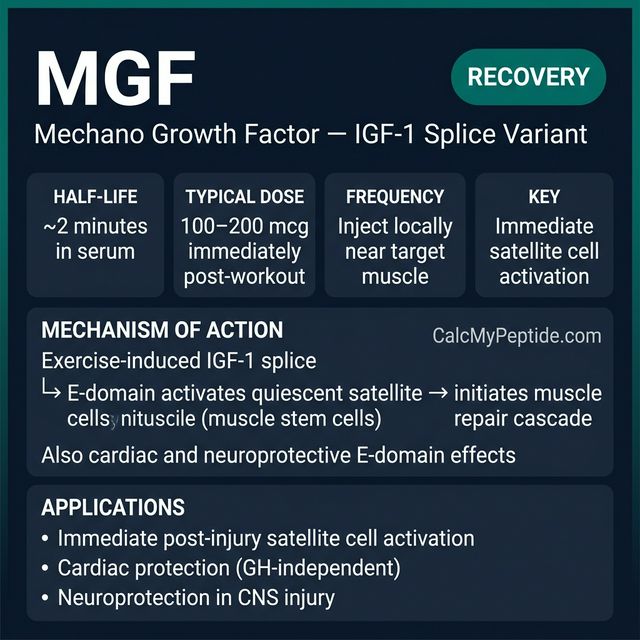
MGF (Mechano Growth Factor, IGF-1Ec) is a splice variant of IGF-1 produced locally in damaged muscle tissue. When muscle fibers experience mechanical load and damage, the IGF-1 gene is spliced differently, producing MGF instead of systemic IGF-1.
MGF activates satellite cells at the injury site, initiating the muscle repair and regeneration process. Its extremely short half-life (~5-7 minutes) means it acts as a local signal — it must be injected directly into or near the target muscle to be effective.
Source: PMID: 12620066
📜Background & History
MGF (Mechano Growth Factor) is the native, non-PEGylated splice variant of IGF-1 generated after mechanical load or injury. It contains a unique 24-amino-acid E-domain that distinguishes it from systemic IGF-1 and specifically activates quiescent muscle satellite cells. The E-domain peptide has also been shown to have direct cardiac and neuroprotective effects independent of satellite cell activation. Its 2-minute half-life in blood means local injection near muscle is essential for activity.
🎯 Research Use Cases
- ✓Immediate post-injury satellite cell activation (inject locally)
- ✓Cardiac protection post-ischemia via independent E-domain mechanism
- ✓Neuroprotection in CNS injury models
💉 Dosing Protocol
| Typical Dose | 100-200 mcg per site |
| Frequency | 1× daily (post-training) |
| Half-Life | ~5-7 minutes |
| Common Vial Sizes | 2 mg, 5 mg |
🧪 Reconstitution Example
⚠️Safety & Considerations
Research peptide. Must be injected locally (intramuscular or subcutaneous near target). Very short half-life means systemic injection is ineffective. Use immediately after reconstitution for best results.
⚡Interactions & Contraindications
Must be injected directly into or near target muscle tissue due to 2-minute serum half-life. No systemic activity from non-local injection. As an IGF-1 family peptide: contraindicated with active cancer. Localized hypoglycemia risk at injection site is minimal.
🔗Synergies & Common Stacks
MGF provides immediate local satellite cell activation (short burst); PEG-MGF extends this signal for 48-72 hours. Sequential protocol for maximum muscle repair.
MGF activates satellite cells; IGF-1 LR3 drives them to proliferate and differentiate. Complete myogenic cascade activation.
❓ Frequently Asked Questions
Why must MGF be injected locally?▼
When should I inject MGF?▼
📖 References
- Goldspink G. “Mechano growth factor splice variant of IGF-I and muscle repair.” J Physiol (2005). PMID: 15845583