
Two Powerhouses, Completely Different Mechanisms
GHK-Cu and retinol are both proven anti-aging actives with robust evidence. But they work through entirely different biological mechanisms, and understanding these mechanisms helps you decide which to use — or how to use both.
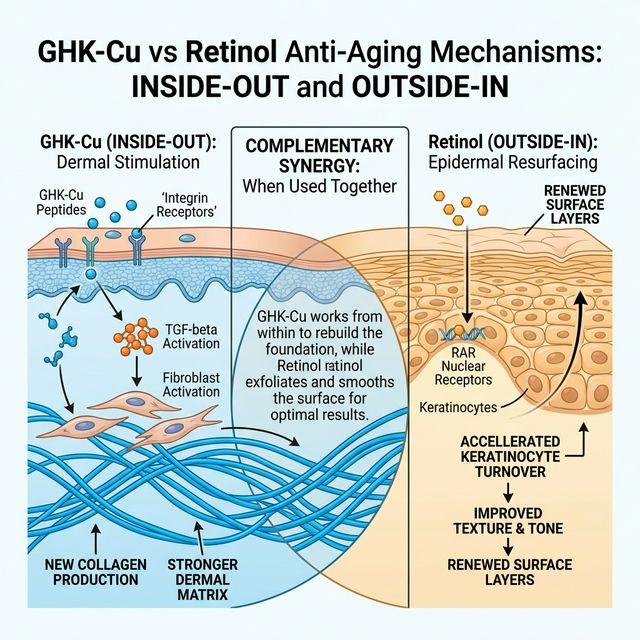
GHK-Cu (glycyl-L-histidyl-L-lysine copper complex) is a naturally occurring tripeptide that declines with age. At age 20, blood GHK-Cu levels are approximately 200 ng/mL. By age 60, levels drop to approximately 80 ng/mL — a 60% decline. Supplementing GHK-Cu restores this signaling molecule to youthful concentrations. Its mechanism: GHK-Cu activates fibroblasts through integrin receptor binding and TGF-β signaling, directly upregulating collagen synthesis, elastin production, and glycosaminoglycan deposition. It is an inside-out approach — regenerating the dermal infrastructure from within.
Retinol (vitamin A) works from the outside in. Applied topically, retinol converts to retinoic acid (tretinoin) in the skin, where it binds nuclear retinoic acid receptors (RARs and RXRs) that regulate gene expression in keratinocytes and fibroblasts. The effects: increased epidermal turnover (fresh skin cells replace old ones faster), stimulation of collagen production in the papillary dermis, inhibition of collagenase (MMP-1), and normalization of melanocyte activity (reducing hyperpigmentation).
Efficacy Evidence: What the Science Shows
Retinol has arguably the strongest evidence base of any topical anti-aging ingredient. Tretinoin (prescription-strength retinoid) has been studied in over 100 clinical trials spanning more than 30 years. The consistent finding: 0.025-0.1% tretinoin applied topically for 12-48 weeks significantly reduces fine wrinkles, improves skin texture, increases dermal collagen density, and reduces hyperpigmentation. Over-the-counter retinol (which converts to tretinoin in skin) produces similar but milder effects at a slower timeline.
GHK-Cu evidence is more recent and more limited in topical form but compelling in the gene expression data. Pickart et al. documented genome-wide effects of GHK-Cu, with upregulation of 31 ECM-related genes and the ability to reprogram gene expression toward regenerative patterns. Clinical studies of topical GHK-Cu show measurable improvements in skin density, firmness, and wrinkle reduction over 12 weeks — comparable in magnitude to mild retinol preparations.
The injectable GHK-Cu data is where the peptide potentially exceeds topical retinol: subcutaneous or intradermal GHK-Cu delivers the tripeptide at concentrations far higher than any topical cream can achieve in the dermis. The fibroblast activation is direct and potent. However, no head-to-head clinical trial has compared injectable GHK-Cu to tretinoin — such a trial would be extremely informative but does not exist.
Practical Comparison: Application, Side Effects, Cost
Retinol: applied topically once daily (PM), typically at 0.3-1% concentration. Side effects include dryness, peeling, redness, and sun sensitivity — collectively called the "retinization" period, lasting 2-6 weeks. Must be paired with sunscreen. Cost: $10-60/month for OTC retinol; $20-100/month for prescription tretinoin. This is the easiest, most accessible anti-aging intervention.
Topical GHK-Cu: applied as a serum or cream (typical concentration 0.01-0.1%). Minimal side effects — no dryness, no peeling, no sun sensitivity. Can be layered with retinol. Cost: $30-80/month for quality copper peptide serums. This is a gentle complement to retinol, not a replacement.
Injectable GHK-Cu: 200-600 mcg subcutaneously daily for 30-60 day cycles. No topical side effects, but requires reconstitution and injection. Cost: $40-100/month for research-grade peptide. This is the most potent approach for dermal collagen regeneration but also the most complex.
The Smart Approach: Use Both
GHK-Cu and retinol are not competitors — they work through different mechanisms and target different layers of the skin. The optimal evidence-based anti-aging protocol combines both: retinol (topical, nightly) provides epidermal turnover acceleration, MMP-1 inhibition, and surface-level collagen stimulation. GHK-Cu (topical or injectable) provides direct fibroblast activation, deep dermal collagen synthesis, and elastin restoration.
A protocol many practitioners recommend: tretinoin 0.025-0.05% cream nightly (start low, build tolerance), plus GHK-Cu serum in the morning or injectable GHK-Cu for deeper dermal effects. Paired with daily sunscreen SPF 30+ (mandatory with retinoid use) and oral hydrolyzed collagen 10 g/day for systemic support.
This three-layer approach (topical retinoid + copper peptide + oral collagen) represents current best-practice synergy for evidence-based skin aging. Each layer addresses a different mechanism; together, they provide comprehensive dermal and epidermal support.