Understanding Insulin Syringe Units
Insulin syringes measure volume in "units," a convention from diabetes care. The key relationships:
• 100 units = 1 mL (for a U-100 syringe, the standard in the US)
• 1 unit = 0.01 mL
• 50 units = 0.5 mL
• 10 units = 0.1 mL
When working with peptides, "units" refers to these volume-based syringe units — not to biological units like IU (International Units) of HGH.
Syringe Sizes for Peptide Use
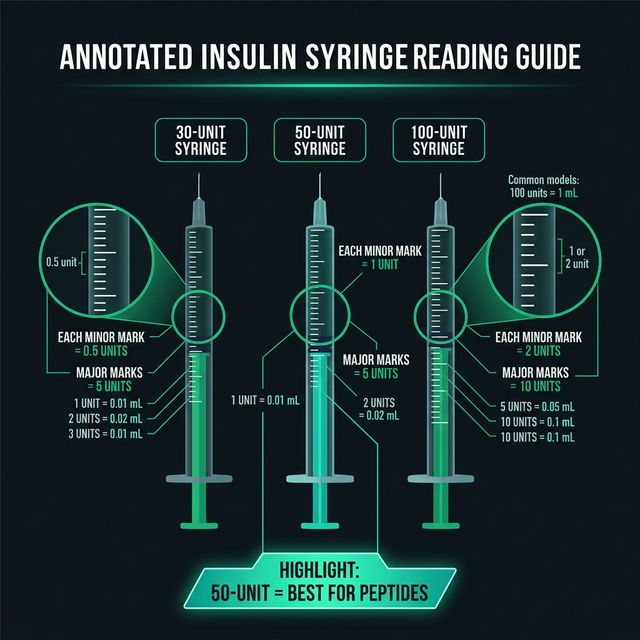
0.3 mL (30 units) — The smallest available. Best for micro-doses. Each tick mark = 0.5 units for maximum precision. Use when your dose volume is under 15 units.
0.5 mL (50 units) — The most popular for peptide use. Each tick mark = 1 unit. Offers good precision for typical peptide doses of 5-30 units.
1.0 mL (100 units) — Best for larger volumes or GLP-1 injections. Each tick mark = 2 units on some models (read carefully!). Use when your dose volume exceeds 30 units.
How to Read Tick Marks
Each syringe has major numbered lines (e.g., 10, 20, 30) and minor tick marks between them. The spacing depends on the syringe size:
• 30-unit syringe: minor ticks = 0.5 units (finest precision)
• 50-unit syringe: minor ticks = 1 unit
• 100-unit syringe: minor ticks = 2 units (be careful!)
Always draw to the top of the plunger line (the flat edge closest to the needle), not the dome.
Needle Gauge and Length
Peptide injections are subcutaneous (under the skin), not intramuscular. Recommended needles:
• Gauge: 29g to 31g (higher = thinner = less pain)
• Length: ½ inch (12.7 mm) is standard for subcutaneous injection
• 5/16 inch (8 mm) works for leaner individuals
Most insulin syringes come with permanently attached needles in these specifications.
Converting Your Dose to Syringe Units
Use this formula with our Reconstitution Calculator:
Example: 10 mg vial + 2 mL water using a 100-unit syringe. mcg per unit = 10,000 ÷ 2 ÷ 100 = 50 mcg/unit. For a 300 mcg dose: 300 ÷ 50 = 6 units.
Tips for Accurate Measurement
• Flick the syringe to move air bubbles to the top, then push them out before injecting
• Draw slightly more than needed, then push back to your target line to clear dead space
• Hold the syringe at eye level to verify the measurement
• Use the same syringe brand consistently — tick mark spacing varies between manufacturers