TB-500
Thymosin beta-4 fragment studied for wound healing, inflammation reduction, and cardiac repair.
🔬 Mechanism of Action
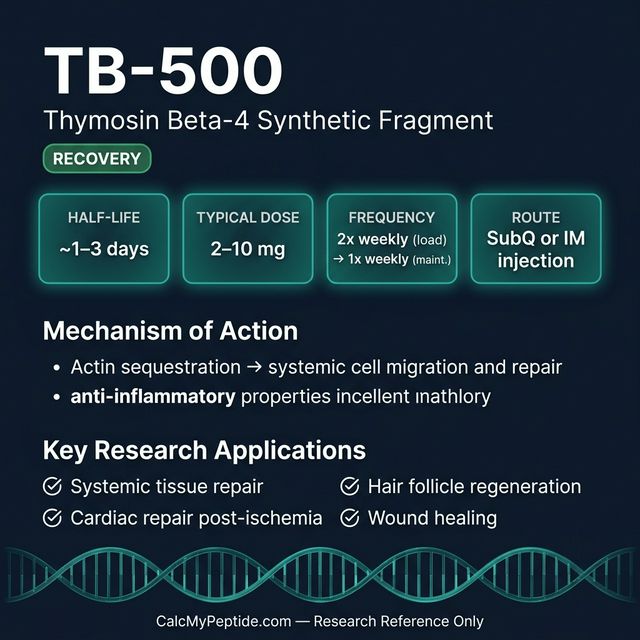
TB-500 is a synthetic version of Thymosin Beta-4 (Tβ4), a 43-amino-acid protein naturally produced by the thymus gland. Its primary mechanism involves regulation of actin, a cell-building protein critical for cell migration, wound healing, and tissue repair. TB-500 promotes actin polymerization, enabling cells to migrate to injury sites more efficiently.
TB-500 also stimulates angiogenesis (new blood vessel formation), reduces inflammation, and promotes the formation of new muscle fibers. It has been studied extensively in equine medicine for tendon and ligament repair. Its systemic distribution means it does not need to be injected at the injury site — it locates and repairs damaged tissue throughout the body.
Source: PMID: 20435714
📜Background & History
Thymosin Beta-4 (Tβ4) was first identified in 1966 by Allan Goldstein at the National Cancer Institute as a thymic hormone involved in immune regulation. TB-500 is the synthetic form of the active region of Tβ4 (amino acids 17–23). It became widely studied in equine sports medicine in the 2000s after showing dramatic efficacy for tendon and muscle repair in racehorses, which led to its ban by racing authorities and subsequent interest in human applications.
🎯 Research Use Cases
- ✓Systemic tissue repair without site-specific injection
- ✓Cardiac muscle repair and protection post-ischemia
- ✓Reducing inflammation in chronic musculoskeletal conditions
- ✓Hair follicle regeneration and wound healing
- ✓Post-surgical recovery acceleration
💉 Dosing Protocol
| Typical Dose | 2-5 mg twice weekly |
| Frequency | 2× weekly (loading), 1× weekly (maintenance) |
| Half-Life | ~2 hours (active metabolites longer) |
| Common Vial Sizes | 5 mg, 10 mg |
🧪 Reconstitution Example
⚠️Safety & Considerations
TB-500 is a research peptide. It is not FDA-approved for human use. Animal studies show a favorable safety profile. Due to its angiogenic properties, TB-500 should not be used by individuals with active cancer. Use sterile injection practices.
⚡Interactions & Contraindications
Contraindicated with active malignancy due to angiogenic activity. May increase healing response in tissues with existing inflammation — start at lower end of dose range. No significant interactions with common medications documented in research.
🔗Synergies & Common Stacks
Classic recovery stack: TB-500 provides systemic, body-wide healing via actin regulation; BPC-157 handles localized vascular and GI repair. Complementary mechanisms with additive effect.
IGF-1 LR3 promotes cellular proliferation while TB-500 facilitates migration of those cells to injury sites, enhancing overall regenerative capacity.
❓ Frequently Asked Questions
What is the typical TB-500 dosing protocol?▼
How long does TB-500 take to work?▼
What is the difference between TB-500 and Thymosin Beta-4?▼
📖 References
- Malinda KM, et al. “Thymosin beta-4 promotes dermal healing.” J Invest Dermatol (1999). PMID: 10469329
- Bock-Marquette I, et al. “Thymosin β4 and cardiac repair.” Nature (2004). PMID: 15229613
- Srivastava D, et al. “Thymosin beta-4 activates integrin-linked kinase and promotes cardiac cell migration, survival, and cardiac repair.” Ann N Y Acad Sci (2007). PMID: 17911436